
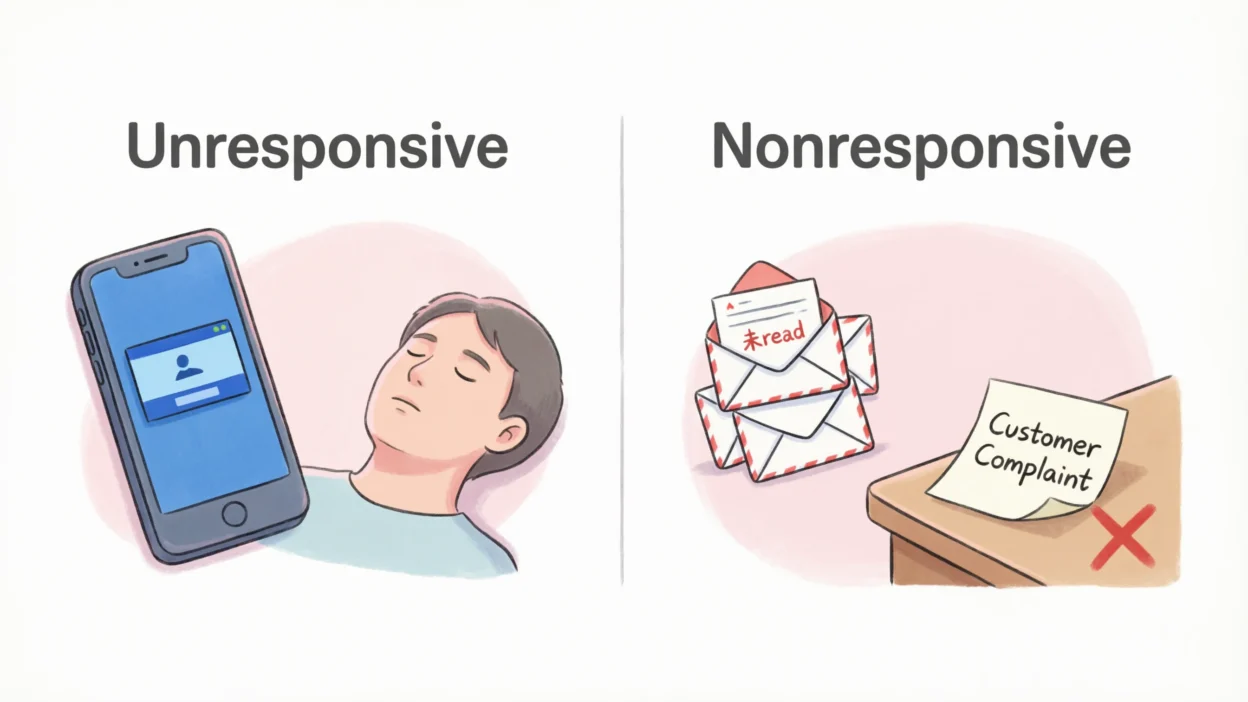
“Unresponsive” and “nonresponsive” are very similar words in English, and both describe a lack of reaction or response. However, there are slight differences in tone, usage, and context.
The key idea: temporarily not reacting vs generally failing to respond.
Understanding the difference will help you use these terms more naturally in medical, technical, business, and everyday English.
Quick Answer
- ✅ Unresponsive – Not reacting or replying, often temporarily
- ✅ Nonresponsive – Failing to respond or not designed to respond
- ✏️ Remember: Unresponsive = no reaction now, Nonresponsive = lacking responsiveness generally
Clear Explanation
What Does “Unresponsive” Mean?
Unresponsive is an adjective.
👉 It means:
- not reacting
- not replying
- not responding to stimuli, communication, or actions
Examples:
- The patient became unresponsive.
- My phone is unresponsive.
- He remained unresponsive to criticism.
- The website became unresponsive during heavy traffic.
- She was emotionally unresponsive.
👉 “Unresponsive” often suggests:
- a temporary condition
- sudden lack of reaction
- inability to respond at the moment
Common Uses of “Unresponsive”
1. Medical Situations
Examples:
- unresponsive patient
- unresponsive child
Example Sentence:
- Doctors treated the unresponsive patient immediately.
2. Technology Problems
Examples:
- unresponsive app
- unresponsive computer
Example Sentence:
- The software became unresponsive after the update.
3. Emotional or Social Contexts
Examples:
- emotionally unresponsive
- unresponsive audience
Example Sentence:
- The crowd seemed unresponsive to the speech.
What Does “Nonresponsive” Mean?
Nonresponsive is also an adjective.
👉 It means:
- failing to respond
- not designed to respond
- consistently lacking response
Examples:
- The company was nonresponsive to complaints.
- Some tumors are nonresponsive to treatment.
- The agency remained nonresponsive for weeks.
- Nonresponsive systems require replacement.
- The customer support team appeared nonresponsive.
👉 “Nonresponsive” often implies:
- an ongoing pattern
- lack of cooperation
- ineffective response behavior
Common Uses of “Nonresponsive”
1. Business or Communication
Examples:
- nonresponsive client
- nonresponsive support team
Example Sentence:
- The vendor became completely nonresponsive.
2. Medical Treatment
Examples:
- nonresponsive to medication
- nonresponsive therapy results
Example Sentence:
- The condition was nonresponsive to treatment.
3. Systems or Organizations
Examples:
- nonresponsive system
- nonresponsive administration
Example Sentence:
- Citizens criticized the nonresponsive government office.
Key Difference
| Feature | Unresponsive | Nonresponsive |
|---|---|---|
| Meaning | Not reacting at the moment | Failing to respond generally |
| Tone | Often temporary | Often ongoing/systematic |
| Common Contexts | Medical, technology | Business, medical, systems |
| Example | Unresponsive phone | Nonresponsive customer support |
Which One to Use and When
Use “Unresponsive” When:
- Talking about temporary lack of reaction
- Referring to devices, people, or systems currently not responding
Examples:
- Unresponsive patient
- Unresponsive app
- Unresponsive screen
- Unresponsive audience
- Unresponsive behavior
Example Sentences:
- My laptop became unresponsive.
- The patient was briefly unresponsive.
- The crowd seemed unresponsive during the presentation.
Use “Nonresponsive” When:
- Talking about ongoing lack of response
- Referring to systems, organizations, or treatment failures
Examples:
- Nonresponsive company
- Nonresponsive treatment
- Nonresponsive customer service
- Nonresponsive organization
- Nonresponsive administration
Example Sentences:
- The agency remained nonresponsive for months.
- The illness was nonresponsive to medication.
- Support staff became nonresponsive after the complaint.
Common Mistakes People Make
1. Treating the Words as Perfect Synonyms
They overlap, but tone differs slightly.
2. Using “Nonresponsive” for Temporary Device Problems
❌ My phone is nonresponsive right now
✅ My phone is unresponsive right now
👉 “Unresponsive” sounds more natural for temporary tech issues.
3. Using “Unresponsive” for Long-Term Organizational Failure
❌ The company stayed unresponsive for years
✅ The company stayed nonresponsive for years
👉 “Nonresponsive” better suggests a persistent pattern.
4. Ignoring Context
- temporary → unresponsive
- ongoing/systematic → nonresponsive
5. Forgetting Medical Differences
Both words appear in medical English, but usage varies by context.
Easy Memory Trick
👉 Unresponsive = not reacting now
👉 Nonresponsive = generally failing to respond
Think:
- frozen phone → unresponsive
- ignoring emails repeatedly → nonresponsive
Real-Life Examples
Correct Use of “Unresponsive”
- The patient became suddenly unresponsive.
- My computer is unresponsive after the update.
- The audience remained unresponsive.
Correct Use of “Nonresponsive”
- The company was nonresponsive to complaints.
- The disease was nonresponsive to treatment.
- Officials criticized the nonresponsive system.
Practice Exercise
Fill in the blanks:
- My laptop became completely ______.
- The company stayed ______ to customer complaints.
- The patient was briefly ______ after surgery.
Answers:
- unresponsive
- nonresponsive
- unresponsive
Quick Quiz
- Which word often suggests a temporary lack of reaction?
a) Nonresponsive
b) Unresponsive - Which word often suggests an ongoing failure to respond?
a) Unresponsive
b) Nonresponsive - Which sentence sounds more natural?
a) My app is nonresponsive right now
b) My app is unresponsive right now
Correct Answers:
- b) Unresponsive
- b) Nonresponsive
- b) My app is unresponsive right now
Why This Confusion Happens
The confusion happens because:
- both words involve lack of response
- meanings overlap heavily
- both are common in professional English
However:
- unresponsive often refers to a current temporary state
- nonresponsive often refers to persistent or systematic failure
Helpful Tip for Better Writing
If the sentence involves:
- temporary reaction problems → use unresponsive
- long-term or repeated failure to respond → use nonresponsive
Conclusion
The difference between “unresponsive” and “nonresponsive” is mainly about tone and context. Unresponsive usually describes a temporary lack of reaction, while nonresponsive suggests a more ongoing or systematic failure to respond.
👉 Unresponsive = temporary no reaction
👉 Nonresponsive = ongoing lack of response
Learning this distinction will help your English sound more accurate and professional.

Michael Anderson is a professional editor and senior contributor with a background in long-form content and strategic writing. He focuses on quality, structure, and credibility across all publications. Michael brings years of experience in content development and ensures high editorial standards for every project.