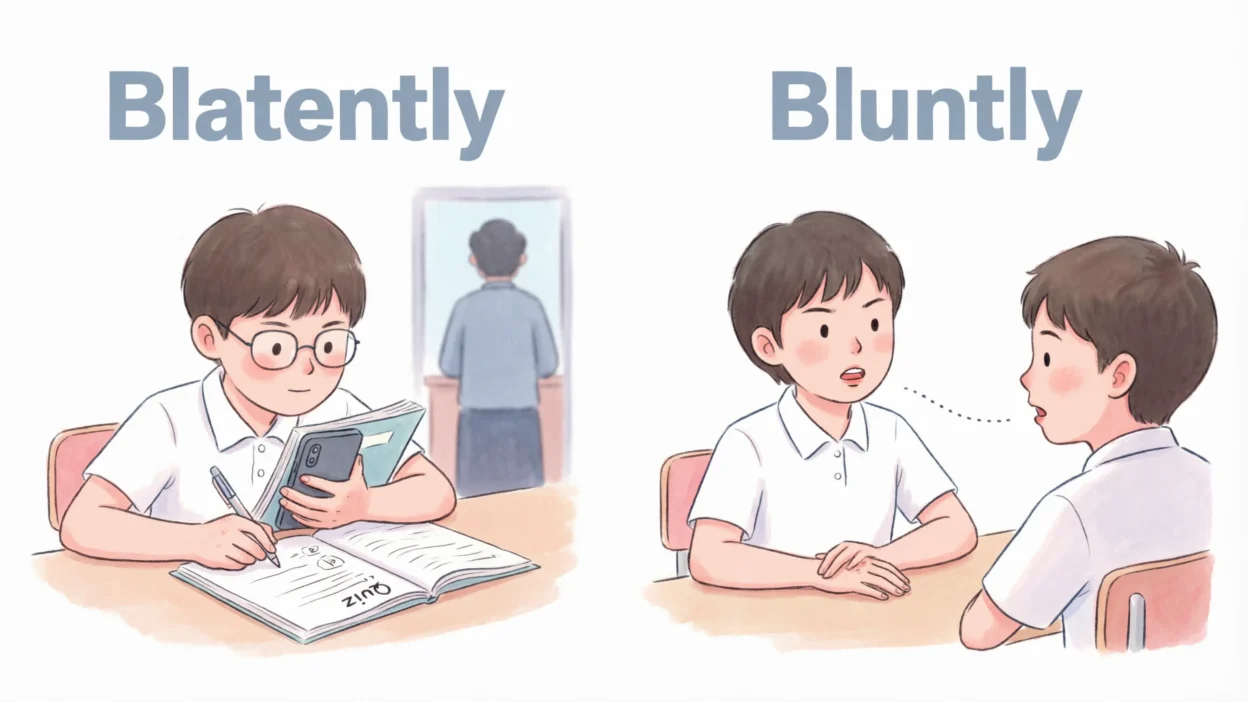
“Blatantly” and “bluntly” are often confused because both can describe direct or obvious behavior. However, they have different meanings and are used in different situations.
The key idea: obviously/openly vs directly/frankly.
Understanding the difference will help you communicate more clearly and avoid common English mistakes.
Quick Answer
- ✅ Blatantly – In an obvious, open, or shameless way
- ✅ Bluntly – In a direct or straightforward way without softness
- ✏️ Remember: Blatantly = obvious, Bluntly = direct
Clear Explanation
What Does “Blatantly” Mean?
Blatantly is an adverb.
👉 It means:
- obviously
- openly
- in a way that is impossible to ignore
- sometimes shamelessly
Examples:
- He blatantly ignored the rules.
- The company blatantly copied the design.
- She was blatantly lying.
- The mistake was blatantly obvious.
- They blatantly violated the law.
👉 “Blatantly” often has:
- a negative tone
- criticism
- emphasis on obvious behavior
Common Uses of “Blatantly”
1. Breaking Rules Openly
Examples:
- blatantly cheating
- blatantly stealing
Example Sentence:
- The player was blatantly cheating during the match.
2. Obvious Mistakes or Lies
Examples:
- blatantly false
- blatantly incorrect
Example Sentence:
- His statement was blatantly inaccurate.
3. Shameless Behavior
Examples:
- blatantly rude
- blatantly disrespectful
Example Sentence:
- They blatantly ignored safety warnings.
What Does “Bluntly” Mean?
Bluntly is also an adverb.
👉 It means:
- directly
- honestly
- without softening words
Examples:
- She spoke bluntly about the problem.
- To put it bluntly, the plan failed.
- He bluntly refused the offer.
- The manager bluntly criticized the idea.
- She answered bluntly but honestly.
👉 “Bluntly” often describes:
- frank speech
- straightforward communication
- honesty without politeness
Common Uses of “Bluntly”
1. Direct Opinions
Examples:
- bluntly speaking
- bluntly stated
Example Sentence:
- He bluntly explained the risks.
2. Honest Criticism
Examples:
- bluntly criticize
- bluntly reject
Example Sentence:
- The coach bluntly criticized the team’s performance.
3. Straightforward Communication
Examples:
- bluntly answered
- bluntly admitted
Example Sentence:
- She bluntly admitted the mistake.
Key Difference
| Feature | Blatantly | Bluntly |
|---|---|---|
| Meaning | Obviously/openly | Directly/frankly |
| Tone | Often negative | Honest/direct |
| Focus | Visibility or shamelessness | Communication style |
| Example | Blatantly cheating | Bluntly speaking |
Which One to Use and When
Use “Blatantly” When:
- Something is obvious or shameless
- Talking about open wrongdoing or clear behavior
Examples:
- Blatantly lying
- Blatantly cheating
- Blatantly false
- Blatantly rude
- Blatantly ignoring rules
Example Sentences:
- The advertisement was blatantly misleading.
- He blatantly ignored instructions.
- They blatantly copied another company’s design.
Use “Bluntly” When:
- Talking about direct speech or honesty
- Referring to straightforward communication
Examples:
- Bluntly speaking
- Bluntly refused
- Bluntly criticized
- Bluntly answered
- Bluntly admitted
Example Sentences:
- She bluntly told him the truth.
- The manager bluntly rejected the proposal.
- To put it bluntly, the project failed.
Common Mistakes People Make
1. Using “Blatantly” for Direct Speech
❌ He blatantly told the truth
✅ He bluntly told the truth
👉 “Bluntly” describes speaking style.
2. Using “Bluntly” for Obvious Wrongdoing
❌ They bluntly cheated
✅ They blatantly cheated
👉 “Blatantly” emphasizes obvious behavior.
3. Confusing Tone
- blatantly → often negative/shameless
- bluntly → direct/honest
4. Forgetting Context
One describes behavior visibility, the other communication style.
5. Thinking Both Mean “Rude”
Sometimes they overlap, but meanings are different.
Easy Memory Trick
👉 Blatantly = blatantly obvious
👉 Bluntly = blunt speech
Think:
- blatantly cheating
- bluntly speaking
Real-Life Examples
Correct Use of “Blatantly”
- The company blatantly violated regulations.
- He was blatantly dishonest.
- They blatantly ignored the warning signs.
Correct Use of “Bluntly”
- She bluntly explained the situation.
- He bluntly refused to participate.
- The teacher bluntly corrected the student.
Practice Exercise
Fill in the blanks:
- The athlete was ______ cheating during the game.
- She ______ told him the truth.
- The company ______ ignored safety regulations.
Answers:
- blatantly
- bluntly
- blatantly
Quick Quiz
- Which word means “in an obvious or shameless way”?
a) Bluntly
b) Blatantly - Which word describes direct communication?
a) Blatantly
b) Bluntly - Which sentence sounds more natural?
a) He bluntly spoke the truth
b) He blatantly spoke the truth
Correct Answers:
- b) Blatantly
- b) Bluntly
- a) He bluntly spoke the truth
Why This Confusion Happens
The confusion happens because:
- both words can describe strong behavior
- both may sound harsh
- both appear in criticism or conflict situations
However:
- blatantly refers to obvious or shameless actions
- bluntly refers to direct speech or honesty
Helpful Tip for Better Writing
If the sentence involves:
- obvious wrongdoing or shameless behavior → use blatantly
- direct or frank communication → use bluntly
Conclusion
The difference between “blatantly” and “bluntly” is about meaning and context. Blatantly describes something obvious or shameless, while bluntly describes direct and straightforward communication.
👉 Blatantly = openly obvious
👉 Bluntly = directly honest
Learning this distinction will help your English sound clearer and more precise.

Emily Carter is a content writer and editor based in the United States, specializing in lifestyle, wellness, and personal development topics. With a passion for clear and engaging storytelling, she creates content that connects with readers and delivers practical value. Emily focuses on making complex ideas easy to understand and relatable.