
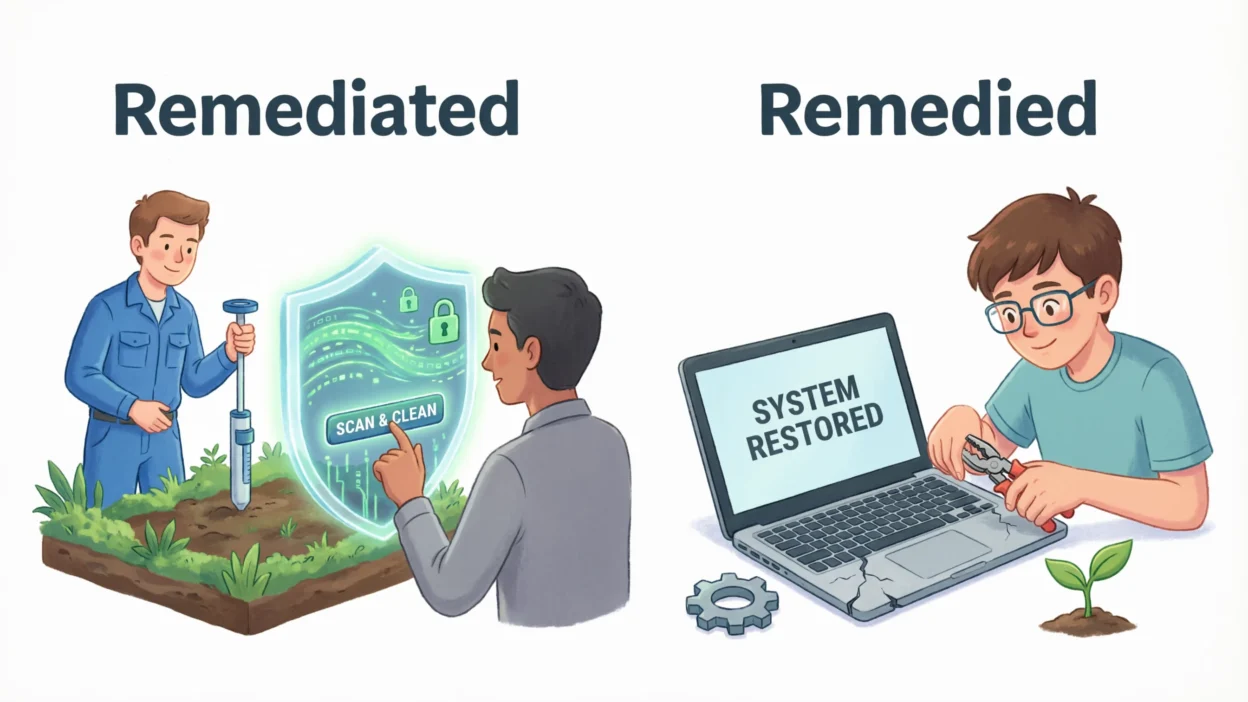
“Remediated” and “remedied” are often confused because both words relate to fixing problems. However, they are used in different contexts and have slightly different meanings.
The key idea: technical correction vs general fixing.
Understanding the difference will help you use these words correctly in professional, academic, environmental, and everyday English.
Quick Answer
- ✅ Remediated – Corrected or cleaned up a problem, often technical or environmental
- ✅ Remedied – Fixed or solved a problem generally
- ✏️ Remember: Remediated = technical correction, Remedied = solved/fixed
Clear Explanation
What Does “Remediated” Mean?
Remediated is the past tense of the verb remediate.
👉 It means:
- corrected a serious issue
- cleaned up contamination or damage
- improved a problem using technical methods
Examples:
- The polluted soil was remediated.
- Engineers remediated the software vulnerability.
- The company remediated environmental damage.
- The school remediated learning gaps.
- Experts remediated the cybersecurity issue.
👉 “Remediated” is commonly used in:
- environmental science
- technology
- cybersecurity
- education
- engineering
Common Uses of “Remediated”
1. Environmental Cleanup
Examples:
- remediated land
- remediated contamination
Example Sentence:
- The factory site was fully remediated.
2. Cybersecurity or Technical Problems
Examples:
- remediated vulnerabilities
- remediated system issues
Example Sentence:
- The IT team remediated the security breach quickly.
3. Educational Improvement
Examples:
- remediated learning problems
- remediated academic gaps
Example Sentence:
- Teachers remediated students’ reading difficulties.
What Does “Remedied” Mean?
Remedied is the past tense of the verb remedy.
👉 It means:
- fixed
- solved
- corrected a problem generally
Examples:
- The issue was remedied quickly.
- They remedied the mistake.
- The company remedied customer complaints.
- The damage was remedied by repairs.
- He remedied the situation immediately.
👉 “Remedied” is broader and more general.
Common Uses of “Remedied”
1. Solving Problems
Examples:
- remedied the issue
- remedied the situation
Example Sentence:
- Management remedied the misunderstanding.
2. Repairing Damage
Examples:
- remedied defects
- remedied errors
Example Sentence:
- The builder remedied the construction problems.
3. Correcting Mistakes
Examples:
- remedied the error
- remedied the complaint
Example Sentence:
- The company remedied customer concerns quickly.
Key Difference
| Feature | Remediated | Remedied |
|---|---|---|
| Meaning | Technically corrected or cleaned up | Fixed or solved generally |
| Tone | Technical/professional | General/common |
| Common Contexts | Environment, IT, education | Everyday problems |
| Example | Remediated contamination | Remedied the issue |
Which One to Use and When
Use “Remediated” When:
- Talking about technical, environmental, or specialized correction
Examples:
- Remediated pollution
- Remediated vulnerabilities
- Remediated deficiencies
- Remediated contamination
- Remediated security flaws
Example Sentences:
- Experts remediated the hazardous waste site.
- The software bug was remediated quickly.
- Teachers remediated learning deficiencies.
Use “Remedied” When:
- Talking about solving general problems or mistakes
Examples:
- Remedied the problem
- Remedied the mistake
- Remedied customer complaints
- Remedied the damage
- Remedied the situation
Example Sentences:
- The issue was remedied immediately.
- They remedied the misunderstanding professionally.
- Repairs remedied the leak.
Common Mistakes People Make
1. Using “Remediated” for Simple Everyday Problems
❌ She remediated the misunderstanding
✅ She remedied the misunderstanding
👉 “Remedied” sounds more natural.
2. Using “Remedied” for Technical Cleanup
❌ The contaminated site was remedied
✅ The contaminated site was remediated
👉 “Remediated” is more precise for technical cleanup.
3. Thinking the Words Are Completely Interchangeable
They overlap, but context matters.
4. Ignoring Technical Tone
“Remediated” sounds more specialized and professional.
5. Confusing Formality Levels
“Remedied” is more common in everyday English.
Easy Memory Trick
👉 Remediated = technical repair/cleanup
👉 Remedied = solved or fixed
Think:
- remediated contamination
- remedied the problem
Real-Life Examples
Correct Use of “Remediated”
- The company remediated the cybersecurity weakness.
- The polluted river was remediated successfully.
- Engineers remediated structural issues.
Correct Use of “Remedied”
- The manager remedied the scheduling problem.
- They remedied the error quickly.
- The repairs remedied the damage.
Practice Exercise
Fill in the blanks:
- The polluted land was ______ by environmental experts.
- The company ______ the customer complaint quickly.
- IT specialists ______ the security flaw.
Answers:
- remediated
- remedied
- remediated
Quick Quiz
- Which word sounds more technical?
a) Remedied
b) Remediated - Which word is more common for everyday problems?
a) Remediated
b) Remedied - Which sentence sounds most natural?
a) The contamination was remedied
b) The contamination was remediated
Correct Answers:
- b) Remediated
- b) Remedied
- b) The contamination was remediated
Why This Confusion Happens
The confusion happens because:
- both words involve fixing problems
- meanings overlap
- both are formal English terms
However:
- remediated is more technical and specialized
- remedied is broader and more general
Helpful Tip for Better Writing
If the sentence involves:
- technical correction or environmental cleanup → use remediated
- general fixing or solving → use remedied
Conclusion
The difference between “remediated” and “remedied” is mainly about context and tone. Remediated usually refers to technical or specialized correction, while remedied means solving or fixing problems more generally.
👉 Remediated = technical correction
👉 Remedied = general solution
Learning this distinction will help you use professional and everyday English more accurately.

Michael Anderson is a professional editor and senior contributor with a background in long-form content and strategic writing. He focuses on quality, structure, and credibility across all publications. Michael brings years of experience in content development and ensures high editorial standards for every project.