
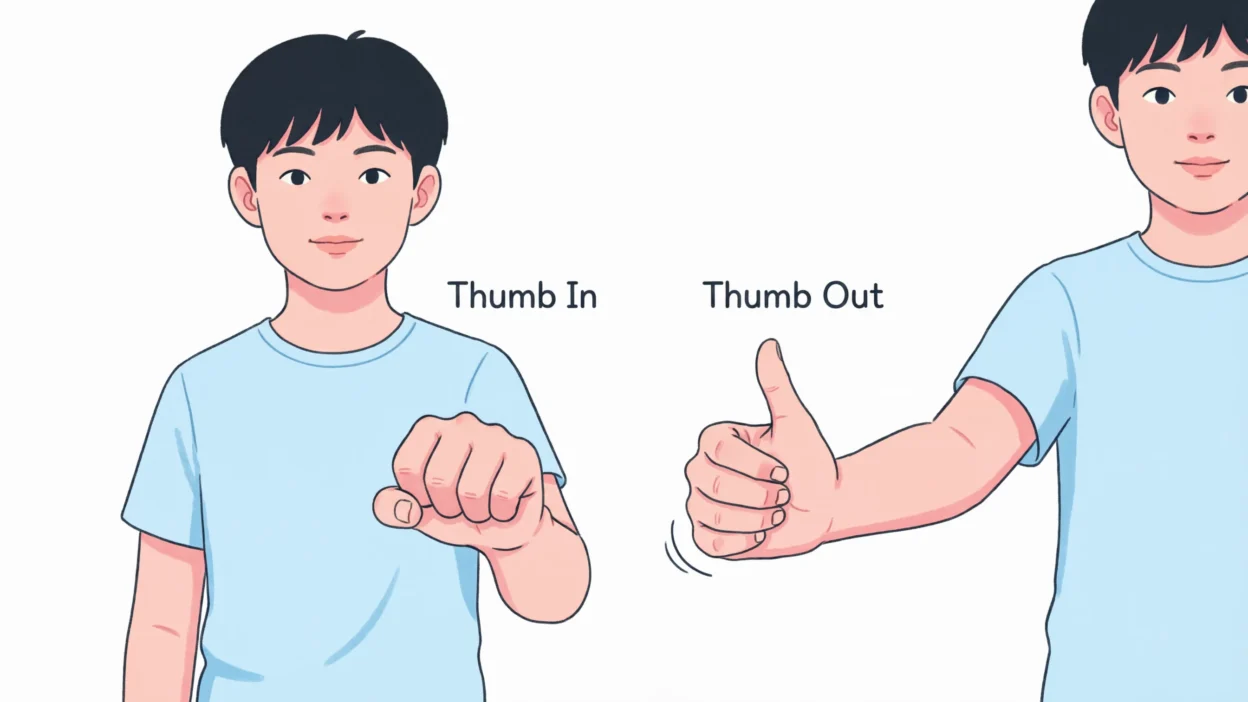
“Thumb in” and “thumb out” are phrases commonly used to describe the position of the thumb during hand gestures, exercises, sports, or body posture. Although they sound simple, they can have very different meanings depending on the context.
The key idea: thumb directed inward vs thumb directed outward.
Understanding the difference is useful in:
- fitness and exercise instructions
- dance or martial arts
- hand positioning
- body language
- sports coaching
Quick Answer
- ✅ Thumb in – Thumb turned inward toward the body or palm
- ✅ Thumb out – Thumb turned outward away from the body or hand
- ✏️ Remember: In = toward the inside, Out = toward the outside
Clear Explanation
What Does “Thumb In” Mean?
Thumb in means:
- the thumb is positioned inward
- the thumb points toward the body, palm, or inside direction
Examples:
- Keep your thumb in while making a fist.
- The dancer rotated her hand with the thumb in.
- Players should keep the thumb in for safety.
- He stood with his thumb in his pocket.
- The coach instructed students to turn thumbs in.
👉 “Thumb in” is often used in:
- exercise instructions
- hand safety guidance
- dance and movement
- posture correction
Common Uses of “Thumb In”
1. Exercise or Fitness
Examples:
- thumbs in position
- turn thumbs in
Example Sentence:
- During the stretch, keep your thumbs in.
2. Safety Instructions
Examples:
- thumb in while gripping
- thumb in for protection
Example Sentence:
- Riders should keep the thumb in while holding the handle.
3. Body Positioning
Examples:
- thumb in pocket
- thumb in posture
Example Sentence:
- He stood casually with one thumb in his pocket.
What Does “Thumb Out” Mean?
Thumb out means:
- the thumb points outward
- the thumb faces away from the body or hand
Examples:
- Point your thumb out during the exercise.
- The hitchhiker held his thumb out.
- Keep thumbs out during the movement.
- She rotated her hands thumbs out.
- The instructor demonstrated a thumb-out grip.
👉 “Thumb out” often appears in:
- exercise directions
- gestures
- hitchhiking
- sports training
Common Uses of “Thumb Out”
1. Hitchhiking Gesture
Examples:
- thumb out for a ride
Example Sentence:
- The traveler stood by the road with his thumb out.
2. Exercise and Stretching
Examples:
- thumbs out rotation
- thumb out grip
Example Sentence:
- Rotate your shoulders with thumbs out.
3. Open Hand Positioning
Examples:
- thumb out stance
- thumb out posture
Example Sentence:
- The instructor demonstrated the thumb-out technique.
Key Difference
| Feature | Thumb In | Thumb Out |
|---|---|---|
| Direction | Toward inside/body | Toward outside/away |
| Focus | Inward positioning | Outward positioning |
| Common Contexts | Grip, posture, safety | Gestures, exercises |
| Example | Thumb in pocket | Thumb out for hitchhiking |
Which One to Use and When
Use “Thumb In” When:
- Referring to inward thumb placement
- Talking about closed or protected hand positioning
Examples:
- Thumb in grip
- Thumb in pocket
- Turn thumbs in
- Keep thumb in
- Thumb in posture
Example Sentences:
- Keep your thumb in while punching.
- The coach told players to turn their thumbs in.
- He stood with both thumbs in his pockets.
Use “Thumb Out” When:
- Referring to outward thumb direction
- Talking about open gestures or rotations
Examples:
- Thumb out gesture
- Thumb out position
- Thumbs out stretch
- Thumb out hitchhiking
- Thumb out grip
Example Sentences:
- She held her thumb out for a ride.
- Rotate your arms with thumbs out.
- The trainer demonstrated a thumb-out position.
Common Mistakes People Make
1. Confusing Direction
- thumb in → inward
- thumb out → outward
2. Ignoring Context
Meaning changes depending on:
- exercise
- gestures
- posture
- sports
3. Assuming Fixed Definitions
These are descriptive phrases, not strict technical terms.
4. Misunderstanding Body Orientation
“In” and “out” depend on body direction or hand position.
5. Forgetting Visual Meaning
The phrases are usually physical and directional.
Easy Memory Trick
👉 Thumb in = inside direction
👉 Thumb out = outside direction
Think:
- thumb in → closer to body
- thumb out → farther from body
Real-Life Examples
Correct Use of “Thumb In”
- Keep your thumb in while gripping the bar.
- The boxer tucked his thumb in safely.
- He stood with a thumb in his pocket.
Correct Use of “Thumb Out”
- The hitchhiker held his thumb out beside the road.
- Rotate your wrists with thumbs out.
- The trainer demonstrated a thumb-out movement.
Practice Exercise
Fill in the blanks:
- The traveler stood beside the road with his thumb ______.
- Keep your thumb ______ while making a fist.
- The instructor said to rotate the arms with thumbs ______.
Answers:
- out
- in
- out
Quick Quiz
- Which phrase describes inward thumb positioning?
a) Thumb out
b) Thumb in - Which phrase is commonly associated with hitchhiking?
a) Thumb in
b) Thumb out - Which sentence sounds correct?
a) Keep your thumb in while making a fist
b) Keep your thumb out while making a fist
Correct Answers:
- b) Thumb in
- b) Thumb out
- a) Keep your thumb in while making a fist
Why This Confusion Happens
The confusion happens because:
- both phrases describe physical direction
- meanings depend on body orientation
- context changes interpretation
However:
- thumb in means inward positioning
- thumb out means outward positioning
Helpful Tip for Better Writing
If the thumb points:
- toward the body or inside → use thumb in
- away from the body or outward → use thumb out
Conclusion
The difference between “thumb in” and “thumb out” is about thumb direction and positioning. Thumb in refers to inward placement toward the body or palm, while thumb out refers to outward placement away from the body.
👉 Thumb in = inward direction
👉 Thumb out = outward direction
Understanding this distinction helps make physical instructions clearer and easier to follow.

Emily Carter is a content writer and editor based in the United States, specializing in lifestyle, wellness, and personal development topics. With a passion for clear and engaging storytelling, she creates content that connects with readers and delivers practical value. Emily focuses on making complex ideas easy to understand and relatable.