
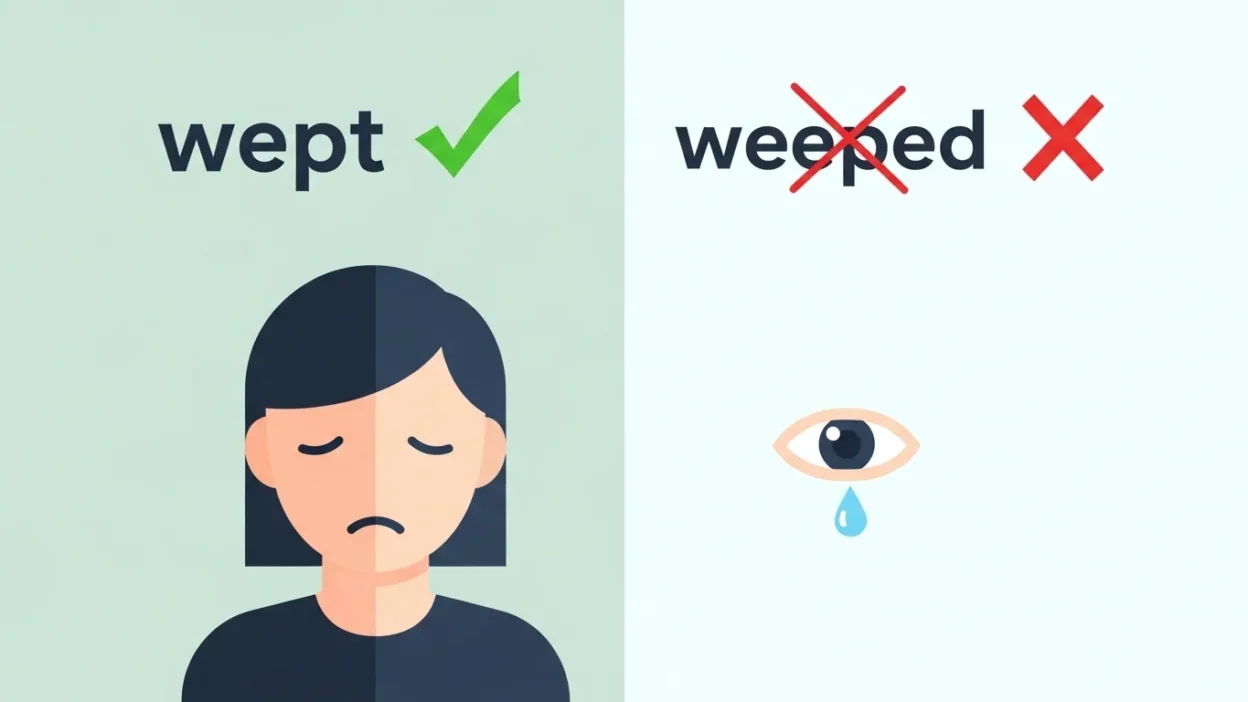
Many learners feel confused between “weeped” and “wept.” These words seem similar because they both relate to the verb “weep,” which means to cry. However, only one of them is correct in standard English.
The confusion happens because English verbs follow different patterns when forming the past tense. Some verbs simply add -ed, while others change their spelling completely. Beginners and ESL learners often assume that “weep” follows the regular pattern, leading to the incorrect form “weeped.”
This article explains the difference in clear, simple English so anyone can understand it easily.
Quick Answer
- Wept = correct past tense and past participle of “weep”
- Weeped = incorrect and nonstandard spelling
✔ Correct: She wept when she heard the sad news.
❌ Incorrect: She weeped when she heard the sad news.
👉 Always use wept.
Simple Origin and Background
The Base Word: “Weep”
- To cry silently or gently
- To shed tears because of sadness or strong emotion
Examples:
- She began to weep quietly.
- He wept with joy.
The word comes from Old English and has been used for centuries in literature and everyday speech.
Regular vs Irregular Verbs
English verbs are divided into two main types:
| Type | Rule | Example |
|---|---|---|
| Regular Verbs | Add -ed to form the past tense | walk → walked |
| Irregular Verbs | Change form completely | weep → wept |
Since weep is an irregular verb, it does not follow the regular -ed pattern.
Clear Explanation of the Difference
What Does “Wept” Mean?
Wept is the correct past tense and past participle of weep. It describes an action of crying that has already happened.
Examples:
- She wept after hearing the news.
- The child wept in silence.
- He has wept many times.
- They wept with happiness at the reunion.
It is commonly used in literature, storytelling, and formal writing.
What About “Weeped”?
Weeped:
- Is not considered correct in modern standard English.
- Is rarely used and generally treated as an error.
- Results from applying the regular -ed rule incorrectly.
Therefore, it should be avoided in academic, professional, and everyday writing.
Comparison Table
| Feature | Wept | Weeped |
|---|---|---|
| Meaning | Past tense of “weep” | Incorrect form |
| Usage | Correct and accepted | Incorrect and nonstandard |
| Verb Type | Irregular verb form | Incorrect regular form |
| Grammar | Proper English | Not accepted in standard usage |
| Use in Exams | Correct | Marked wrong |
| Dictionary Status | Recognized | Generally rejected |
Which One to Use and When
Use “Wept”
Use wept whenever you want to describe crying in the past.
Examples:
- She wept with sorrow.
- He wept at the farewell.
- The mother wept with relief.
- They wept during the emotional ceremony.
- She has wept many times in her life.
Avoid “Weeped”
Never use weeped in:
- School assignments
- Exams and essays
- Professional communication
- Books and formal writing
- Daily conversations
It is considered incorrect in standard English.
Common Mistakes People Make
1. Treating “Weep” as a Regular Verb
Incorrect:
- ❌ weeped
Correct:
- ✔ wept
2. Forgetting Irregular Verb Forms
Many English verbs do not follow standard rules.
Examples:
- sleep → slept
- keep → kept
- sweep → swept
- weep → wept
3. Spelling Based on Assumption
Learners often add -ed automatically without checking whether a verb is irregular.
4. Lack of Practice
Without exposure to irregular verbs, mistakes are common.
Everyday Real-Life Examples
In Literature
- She wept silently in the moonlight.
- The hero wept at the tragic ending.
In Conversations
- He wept when he heard the news.
- She wept with joy at her graduation.
In School Writing
- The character wept after losing his friend.
- The queen wept in the story.
In News and Emotional Contexts
- Families wept during the memorial service.
- The crowd wept with relief when the survivors were rescued.
In Religious or Poetic Contexts
- He wept in prayer.
- The widow wept for her loss.
Short Learning Section for Students and Beginners
Simple Rule to Remember
👉 Weep → Wept (Not Weeped).
Easy Memory Trick
Think:
👉 “Weep sounds like keep, and keep becomes kept.”
So:
- keep → kept
- weep → wept
Practice Sentences
Fill in the blanks:
- She ______ after hearing the sad news.
✔ wept - The child ______ quietly in the corner.
✔ wept - He has ______ many times.
✔ wept
Mini Exercise
Choose the correct word:
- She weeped/wept with joy.
✔ wept - The mother weeped/wept softly.
✔ wept - He has weeped/wept before.
✔ wept - They weeped/wept during the ceremony.
✔ wept
FAQ Section
1. Is “weeped” a real word?
No, it is not accepted in standard modern English.
2. What is the correct past tense of “weep”?
The correct past tense is wept.
3. Is “weep” a regular or irregular verb?
It is an irregular verb.
4. What does “wept” mean?
It means cried or shed tears.
5. Can I use “weeped” in exams?
No. It will be marked incorrect.
6. What is the past participle of “weep”?
The past participle is wept.
7. Is “wept” used in modern English?
Yes, especially in formal, literary, and emotional contexts.
8. What verbs are similar to “weep”?
Similar patterns include:
- keep → kept
- sleep → slept
- sweep → swept
Conclusion
The difference between weeped and wept is simple and clear:
- Wept is the correct past tense and past participle of “weep.”
- Weeped is incorrect and should not be used in standard English.
Understanding irregular verbs is essential for mastering English grammar. By remembering that weep becomes wept, you can avoid mistakes and communicate more effectively.
👉 Final Tip: Always write “wept,” never “weeped.”
With this knowledge, you can write clearly, confidently, and correctly in both academic and everyday English.

Michael Anderson is a professional editor and senior contributor with a background in long-form content and strategic writing. He focuses on quality, structure, and credibility across all publications. Michael brings years of experience in content development and ensures high editorial standards for every project.