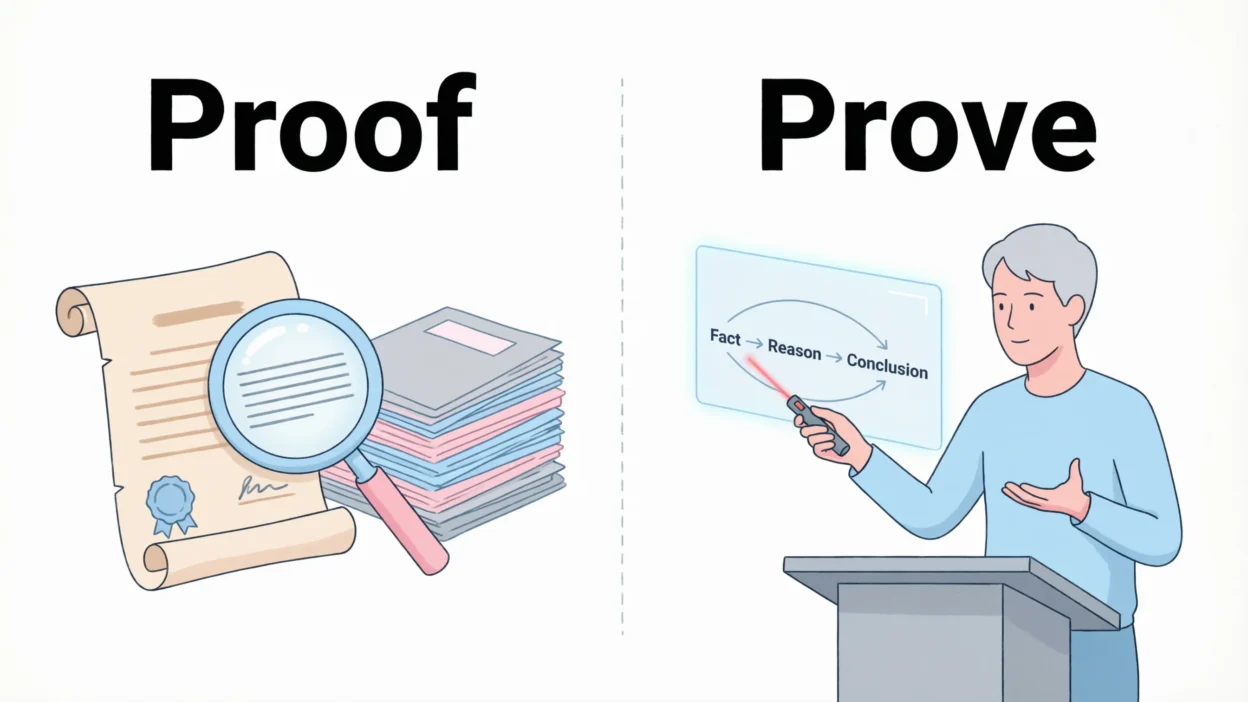
Many English learners confuse “proof” and “prove” because the words are closely related. Both involve showing that something is true, but they are used differently in English grammar.
The key idea: evidence vs action.
Understanding the difference between these two words will help you improve your grammar, writing, and communication skills.
Quick Answer
- ✅ Proof – A noun meaning evidence or confirmation
- ✅ Prove – A verb meaning to demonstrate or show something is true
- ✏️ Remember: Proof = evidence, Prove = action
Clear Explanation
What Does “Proof” Mean?
Proof is usually a noun.
👉 It refers to:
- evidence
- confirmation
- facts that show something is true
Examples:
- Do you have proof of payment?
- The video provided proof of the accident.
- Scientists found proof of the theory.
- There is no proof he was there.
- Her success was proof of hard work.
👉 “Proof” is the thing or evidence itself.
What Does “Prove” Mean?
Prove is a verb.
👉 It means:
- to show
- to demonstrate
- to establish truth with evidence
Examples:
- Can you prove your claim?
- She proved her innocence.
- The experiment proved the theory.
- He wants to prove his skills.
- Facts can prove the truth.
👉 “Prove” is the action of showing evidence.
Key Difference
| Feature | Proof | Prove |
|---|---|---|
| Grammar Type | Noun | Verb |
| Meaning | Evidence | Show evidence |
| Example | Provide proof | Prove a point |
Which One to Use and When
Use “Proof” When:
- Talking about evidence, confirmation, or documentation
Examples:
- Proof of identity
- Proof of payment
- Scientific proof
- Written proof
- Strong proof
Example Sentences:
- We need proof before taking action.
- The photo served as proof.
- There is clear proof of improvement.
Use “Prove” When:
- Talking about the act of demonstrating or confirming something
Examples:
- Prove innocence
- Prove a theory
- Prove a point
- Prove responsibility
- Prove success
Example Sentences:
- She proved everyone wrong.
- The data proved the claim.
- Can you prove your statement?
Grammar Structure Difference
“Proof” as a Noun
👉 Usually follows words like:
- have
- provide
- need
- show
Examples:
- We need proof.
- He provided proof.
- Do you have proof?
“Prove” as a Verb
👉 Usually comes after a subject
Examples:
- They proved the rumor false.
- She can prove it.
- Scientists proved the idea correct.
Common Mistakes People Make
1. Using “Proof” as a Verb
❌ Can you proof it?
✅ Can you prove it?
2. Using “Prove” as a Noun
❌ I need prove
✅ I need proof
3. Confusing Action and Evidence
- prove = action
- proof = evidence
4. Mixing Formal and Informal Usage
“Proof” is very common in business and legal English.
5. Forgetting Verb Forms
“Prove” changes form:
- prove
- proves
- proved
- proven (sometimes used as adjective/past participle)
Understanding “Proven”
People also see:
- proven success
- proven results
👉 “Proven” is related to “prove,” not “proof.”
Examples:
- A proven method
- Proven experience
- Proven facts
Real-Life Examples
Correct Use of “Proof”
- The receipt is proof of purchase.
- Police searched for proof.
- We finally found proof.
Correct Use of “Prove”
- She wants to prove herself.
- The lawyer proved his argument.
- Evidence can prove guilt or innocence.
Easy Memory Trick
👉 Proof = physical evidence
👉 Prove = action of showing evidence
Think:
- You use proof
- You prove something
Practice Exercise
Fill in the blanks:
- Can you ______ your claim?
- The document is ______ of ownership.
- Scientists hope to ______ the theory.
Answers:
- prove
- proof
- prove
Quick Quiz
- Which word is a noun?
a) Prove
b) Proof - Which word is a verb?
a) Proof
b) Prove
Correct Answers:
- b) Proof
- b) Prove
Why This Confusion Happens
The confusion happens because both words come from the same root idea:
- truth
- evidence
- confirmation
However:
- proof became the noun
- prove became the verb
Many English learners accidentally swap them because they are closely connected in meaning.
Helpful Tip for Better Writing
If you can replace the word with:
- evidence → use proof
- demonstrate/show → use prove
Conclusion
The difference between “proof” and “prove” is grammatical and functional. Proof is evidence that something is true, while prove is the action of demonstrating truth.
👉 Proof = evidence
👉 Prove = demonstrate
Learning this difference will help you avoid common English grammar mistakes and improve both speaking and writing accuracy.

Daniel Brooks is a technology and business writer with experience covering innovation, startups, and digital tools. His work emphasizes clarity, accuracy, and real-world application. Daniel aims to help readers understand emerging technologies and make informed decisions in a fast-changing digital landscape.