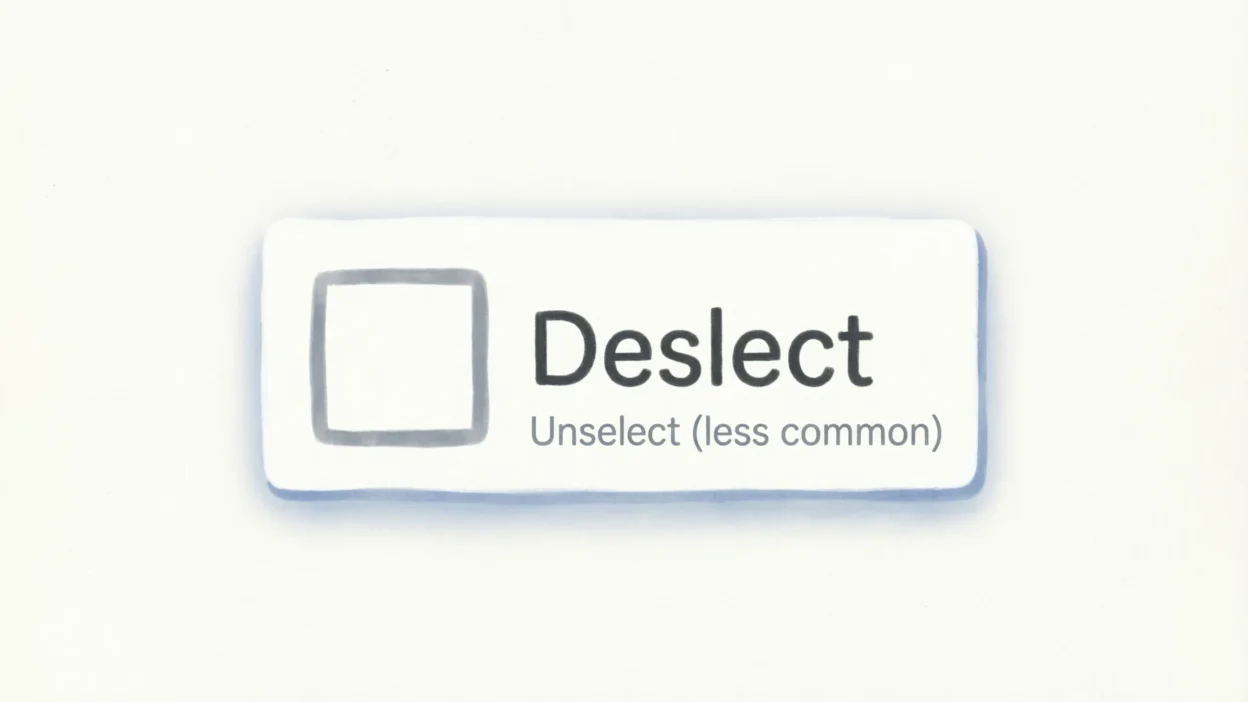
“Unselect” and “deselect” both relate to removing a selection, especially in computers, apps, forms, and digital tools. However, one is much more standard and widely accepted.
The key idea: common technical term vs less standard alternative.
Quick Answer
- ⚠️ Unselect – Informal or less common term
- ✅ Deselect – Standard and preferred term for removing a selection
- ✏️ Remember: Use “deselect” in most situations
Clear Explanation
What Does “Deselect” Mean?
Deselect is a standard verb commonly used in:
- software
- apps
- websites
- digital interfaces
👉 It means:
- to remove a selection
- to unmark something previously selected
Examples:
- Click here to deselect the item.
- Users can deselect multiple files.
- Deselect the checkbox before continuing.
- I accidentally deselected the image.
- Press Escape to deselect the text.
👉 This is the preferred technical term.
What About “Unselect”?
Unselect is sometimes used informally, but it is:
- less common
- less standard
- usually avoided in professional software language
Examples:
- Some apps say “unselect.”
- He tried to unselect the option.
👉 While people may understand it, deselect is generally considered better English.
Key Difference
| Word | Standard? | Meaning |
|---|---|---|
| Unselect | ⚠️ Less common | Remove a selection |
| Deselect | ✅ Preferred | Remove a selection |
Which One to Use and When
Use “Deselect” When:
- Writing professionally
- Designing software or UI
- Giving instructions
Examples:
- Deselect all items
- Deselect the checkbox
- Deselect the image
- Deselect the option
- Deselect selected files
Avoid “Unselect” in Formal Writing
It may still appear in casual speech or older software.
Why “Deselect” Is Preferred
English often uses the prefix:
- de- = remove/reverse
Examples:
- deactivate
- decode
- defrost
- deselect
This makes “deselect” sound more natural and standard.
Common Mistakes People Make
1. Thinking “Unselect” Is Always Wrong
It is understandable, but less standard.
2. Mixing Technical Vocabulary
Professional software usually uses “deselect.”
3. UI Writing Errors
Good user interface writing prefers consistent terminology.
4. Overusing “Un-” Prefixes
Not every English verb naturally uses “un-”.
5. Ignoring Software Standards
Most operating systems use “deselect.”
Easy Memory Trick
👉 Deselect = standard computer term
👉 Think:
- select
- deselect
Real-Life Examples
Correct Use of “Deselect”
- Deselect all photos before deleting.
- Users can deselect rows in the table.
- Tap again to deselect the option.
Less Standard Use of “Unselect”
- Unselect the file if needed. (understood but less preferred)
Practice Exercise
Fill in the blanks:
- Click outside the image to ______ it.
- Users can ______ multiple options.
- Press the button to ______ all files.
Answers:
- deselect
- deselect
- deselect
Quick Quiz
- Which word is preferred in software terminology?
a) Unselect
b) Deselect - Which word is less standard?
a) Deselect
b) Unselect
Correct Answers:
- b) Deselect
- b) Unselect
Conclusion
The difference between “unselect” and “deselect” is mainly about standard usage. Both can mean removing a selection, but deselect is the preferred and professional term in modern English.
👉 Deselect = standard/preferred
👉 Unselect = less common

Michael Anderson is a professional editor and senior contributor with a background in long-form content and strategic writing. He focuses on quality, structure, and credibility across all publications. Michael brings years of experience in content development and ensures high editorial standards for every project.