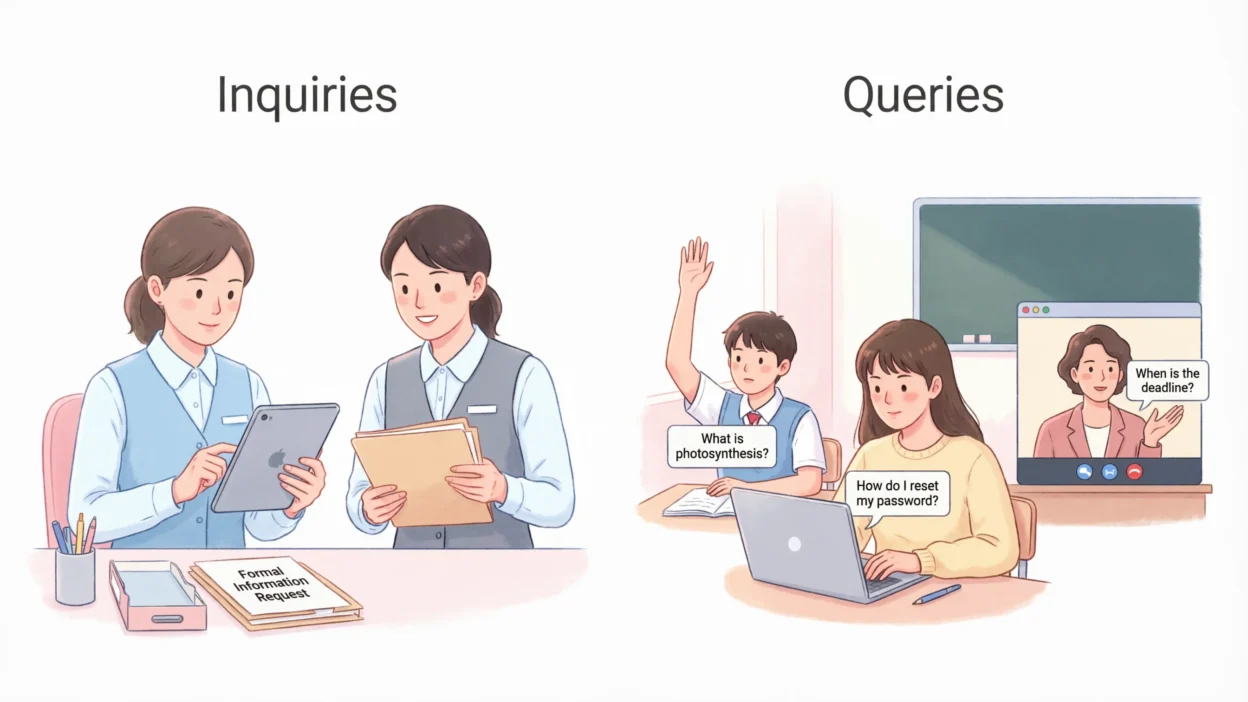
“Inquiries” and “queries” are both related to asking questions, but they are used slightly differently in English depending on context, tone, and formality.
The key idea: formal investigation vs specific question.
Understanding the difference will help you use these words naturally in business, academic, customer service, and everyday English.
Quick Answer
- ✅ Inquiries – Requests for information or formal investigations
- ✅ Queries – Specific questions or doubts needing answers
- ✏️ Remember: Inquiries = broader requests, Queries = direct questions
Clear Explanation
What Does “Inquiries” Mean?
Inquiries is the plural form of inquiry (or enquiry in British English).
👉 It means:
- requests for information
- investigations
- formal attempts to learn something
Examples:
- The company received customer inquiries.
- Police launched several inquiries into the incident.
- Please direct inquiries to the front desk.
- We answered all travel inquiries quickly.
- The school handled parent inquiries professionally.
👉 “Inquiries” often appears in:
- business
- customer service
- formal investigations
- official communication
Common Uses of “Inquiries”
1. Customer Inquiries
Examples:
- customer inquiries
- sales inquiries
- support inquiries
Example Sentence:
- The team responded to customer inquiries within hours.
2. Official Investigations
Examples:
- government inquiries
- public inquiries
- legal inquiries
Example Sentence:
- Authorities opened inquiries into the accident.
3. Requests for Information
Examples:
- travel inquiries
- admission inquiries
- job inquiries
Example Sentence:
- Students made inquiries about scholarships.
What Does “Queries” Mean?
Queries is the plural form of query.
👉 It means:
- questions
- doubts
- requests for clarification
Examples:
- The teacher answered students’ queries.
- Please contact us if you have any queries.
- The client raised several queries about pricing.
- Employees submitted technical queries.
- I have a query regarding my order.
👉 “Queries” usually refers to:
- direct questions
- clarification requests
- smaller or specific issues
Common Uses of “Queries”
1. Customer Questions
Examples:
- billing queries
- account queries
- technical queries
Example Sentence:
- Support staff resolved customer queries quickly.
2. Academic or Workplace Questions
Examples:
- student queries
- employee queries
Example Sentence:
- The professor answered all queries after class.
3. Technology and Databases
In computing, a query can mean:
- a database request or search command
Example:
- The system processed the search query instantly.
Key Difference
| Feature | Inquiries | Queries |
|---|---|---|
| Meaning | Requests for information or investigation | Specific questions or doubts |
| Tone | More formal/broader | More direct/specific |
| Common Contexts | Business, investigations | Questions, customer support |
| Example | Travel inquiries | Technical queries |
Which One to Use and When
Use “Inquiries” When:
- Talking about formal requests or investigations
- Referring to broader information requests
Examples:
- Customer inquiries
- Business inquiries
- Police inquiries
- Admission inquiries
- Travel inquiries
Example Sentences:
- The office handles customer inquiries daily.
- Authorities began inquiries into the issue.
- We received many business inquiries this week.
Use “Queries” When:
- Talking about specific questions or doubts
- Asking for clarification
Examples:
- Technical queries
- Student queries
- Billing queries
- Customer queries
- Database queries
Example Sentences:
- The support team answered all queries.
- I have a query about my account.
- Students raised queries during the lecture.
Common Mistakes People Make
1. Treating Them as Completely Identical
They overlap, but tone and context differ.
2. Using “Queries” for Formal Investigations
❌ Government queries into corruption
✅ Government inquiries into corruption
3. Using “Inquiries” for Small Simple Questions
❌ I have a small inquiry about my password
✅ I have a small query about my password
4. Ignoring Technical Usage
“Query” is common in technology and databases.
5. Confusing American and British English
- inquiry/enquiry
- inquiries/enquiries
Both are correct depending on region.
Easy Memory Trick
👉 Inquiries = investigation/information requests
👉 Queries = questions
Think:
- inquiry → investigate
- query → question
Real-Life Examples
Correct Use of “Inquiries”
- The company received many sales inquiries.
- Officials launched inquiries into the accident.
- Please send inquiries by email.
Correct Use of “Queries”
- The teacher answered all student queries.
- Customers submitted billing queries online.
- I have a query about my order status.
Practice Exercise
Fill in the blanks:
- Police opened several ______ into the case.
- Students asked many ______ after class.
- The office handles customer ______ daily.
Answers:
- inquiries
- queries
- inquiries
Quick Quiz
- Which word is more commonly used for formal investigations?
a) Queries
b) Inquiries - Which word usually means specific questions?
a) Inquiries
b) Queries - Which sentence sounds more natural?
a) Technical inquiries about passwords
b) Technical queries about passwords
Correct Answers:
- b) Inquiries
- b) Queries
- b) Technical queries about passwords
Why This Confusion Happens
The confusion happens because:
- both involve asking for information
- both are common in business English
- both may appear in customer service contexts
However:
- inquiries are broader and more formal
- queries are more direct and question-focused
Helpful Tip for Better Writing
If the sentence involves:
- investigation or formal information requests → use inquiries
- direct questions or clarification → use queries
Conclusion
The difference between “inquiries” and “queries” is mainly about scope and tone. Inquiries usually refer to broader requests for information or formal investigations, while queries refer to specific questions or doubts.
👉 Inquiries = broader/formal requests
👉 Queries = direct questions
Learning this distinction will help you communicate more naturally and professionally in English.

Emily Carter is a content writer and editor based in the United States, specializing in lifestyle, wellness, and personal development topics. With a passion for clear and engaging storytelling, she creates content that connects with readers and delivers practical value. Emily focuses on making complex ideas easy to understand and relatable.