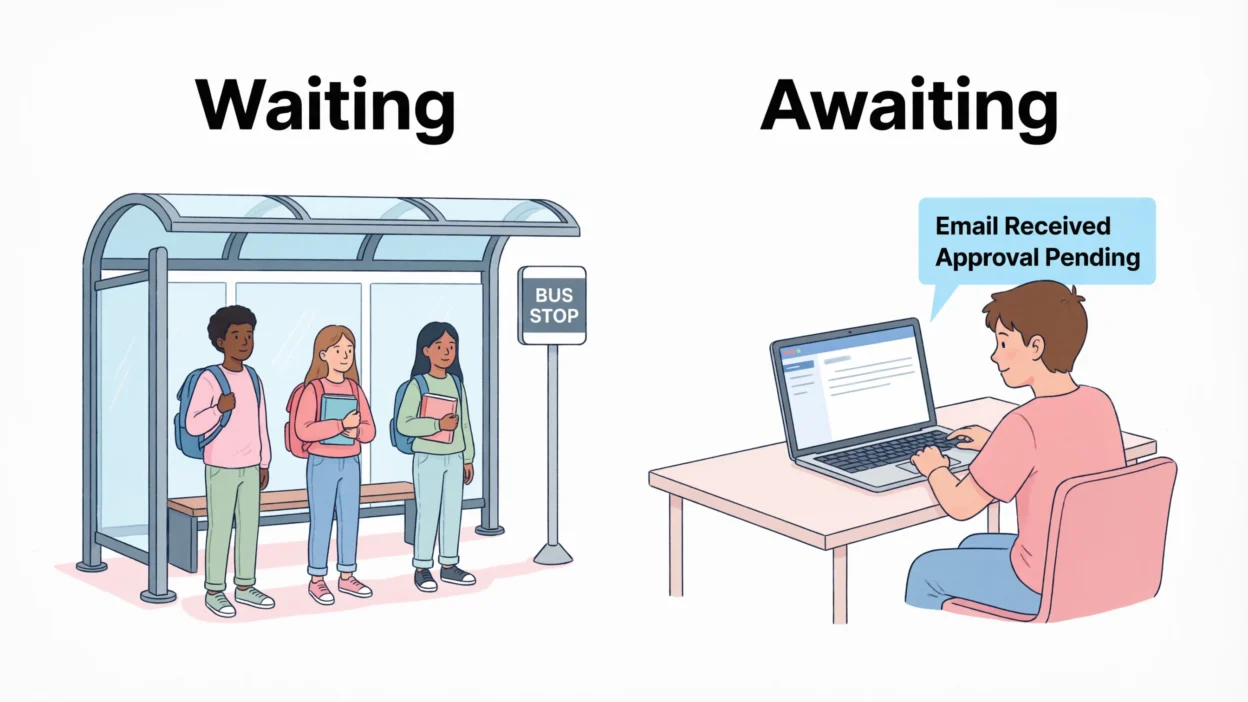
Many English learners confuse “waiting” and “awaiting” because both words involve expecting something to happen. Although their meanings are similar, they differ in grammar, tone, and usage.
The key idea: casual waiting vs formal expectation.
Understanding the difference will help you sound more natural in both spoken and written English.
Quick Answer
- ✅ Waiting – Staying until something happens or someone arrives
- ✅ Awaiting – Formally expecting or waiting for something
- ✏️ Remember: Waiting = everyday use, Awaiting = formal use
Clear Explanation
What Does “Waiting” Mean?
Waiting is the present participle of the verb wait.
👉 It means:
- staying somewhere until something happens
- delaying action while expecting something
Examples:
- I am waiting for the bus.
- She is waiting outside.
- We are waiting for your answer.
- They waited for hours.
- He sat quietly waiting.
👉 “Waiting” is very common in:
- everyday conversations
- casual writing
- spoken English
Common Uses of “Waiting”
1. Waiting for People
Examples:
- waiting for friends
- waiting for customers
Example Sentence:
- She is waiting for her sister.
2. Waiting for Events or Results
Examples:
- waiting for exam results
- waiting for news
Example Sentence:
- Students are waiting for their scores.
3. Waiting in Places
Examples:
- waiting at the station
- waiting in line
Example Sentence:
- We were waiting at the airport.
What Does “Awaiting” Mean?
Awaiting is the present participle of the verb await.
👉 It means:
- expecting something formally
- waiting for something patiently or officially
Examples:
- We are awaiting your response.
- The package is awaiting delivery.
- She is awaiting approval.
- The decision is awaiting confirmation.
- Fans are awaiting the announcement.
👉 “Awaiting” is more common in:
- formal writing
- business English
- professional communication
Important Grammar Difference
“Wait” Usually Uses “For”
✅ waiting for someone
✅ waiting for results
Examples:
- I am waiting for the train.
- They waited for permission.
“Await” Usually Does NOT Use “For”
✅ awaiting approval
✅ awaiting confirmation
❌ awaiting for approval
Examples:
- We await your reply.
- She is awaiting test results.
Key Difference
| Feature | Waiting | Awaiting |
|---|---|---|
| Tone | Casual/common | Formal/professional |
| Grammar | Usually followed by “for” | Usually no “for” |
| Meaning | Staying until something happens | Expecting formally |
| Example | Waiting for the bus | Awaiting approval |
Which One to Use and When
Use “Waiting” When:
- Speaking casually
- Talking about physical waiting
- Using everyday English
Examples:
- Waiting for a friend
- Waiting for the bus
- Waiting in line
- Waiting outside
- Waiting for help
Example Sentences:
- I’m waiting for my order.
- They are waiting outside the building.
- We waited for hours at the station.
Use “Awaiting” When:
- Writing formally
- Talking about official responses or approvals
- Using business or professional language
Examples:
- Awaiting approval
- Awaiting confirmation
- Awaiting payment
- Awaiting instructions
- Awaiting results
Example Sentences:
- Your application is awaiting review.
- We are awaiting further information.
- The shipment is awaiting customs clearance.
Common Mistakes People Make
1. Writing “Awaiting For”
❌ We are awaiting for your reply
✅ We are awaiting your reply
👉 “Await” normally does not use “for.”
2. Using “Awaiting” in Casual Situations
❌ I’m awaiting the bus
✅ I’m waiting for the bus
👉 “Waiting” sounds more natural here.
3. Forgetting Tone Differences
“Awaiting” sounds more official and professional.
4. Confusing Sentence Structure
- wait for something
- await something
5. Overusing “Await”
In normal conversation, “wait” is usually preferred.
Easy Memory Trick
👉 Wait = wait for
👉 Await = already includes the “for” meaning
Think:
- waiting for news
- awaiting approval
Real-Life Examples
Correct Use of “Waiting”
- We are waiting for the train.
- She waited outside for an hour.
- Customers are waiting in line.
Correct Use of “Awaiting”
- The request is awaiting approval.
- They are awaiting test results.
- We await your response.
Practice Exercise
Fill in the blanks:
- We are ______ for the manager.
- The application is ______ approval.
- She is ______ exam results.
Answers:
- waiting
- awaiting
- awaiting
Quick Quiz
- Which word sounds more formal?
a) Waiting
b) Awaiting - Which sentence is correct?
a) Awaiting for confirmation
b) Awaiting confirmation - Which phrase sounds more natural in casual conversation?
a) Awaiting the bus
b) Waiting for the bus
Correct Answers:
- b) Awaiting
- b) Awaiting confirmation
- b) Waiting for the bus
Why This Confusion Happens
The confusion happens because:
- both words involve expectation
- meanings are similar
- both describe future events
However:
- waiting is casual and conversational
- awaiting is formal and professional
Helpful Tip for Better Writing
If the sentence is:
- casual or spoken → use waiting
- formal or official → use awaiting
Conclusion
The difference between “waiting” and “awaiting” is mainly about tone and grammar. Waiting is the common everyday word usually followed by “for,” while awaiting is a more formal word that directly takes an object without “for.”
👉 Waiting = everyday English
👉 Awaiting = formal English
Learning this distinction will help you communicate more naturally and professionally.

Emily Carter is a content writer and editor based in the United States, specializing in lifestyle, wellness, and personal development topics. With a passion for clear and engaging storytelling, she creates content that connects with readers and delivers practical value. Emily focuses on making complex ideas easy to understand and relatable.