
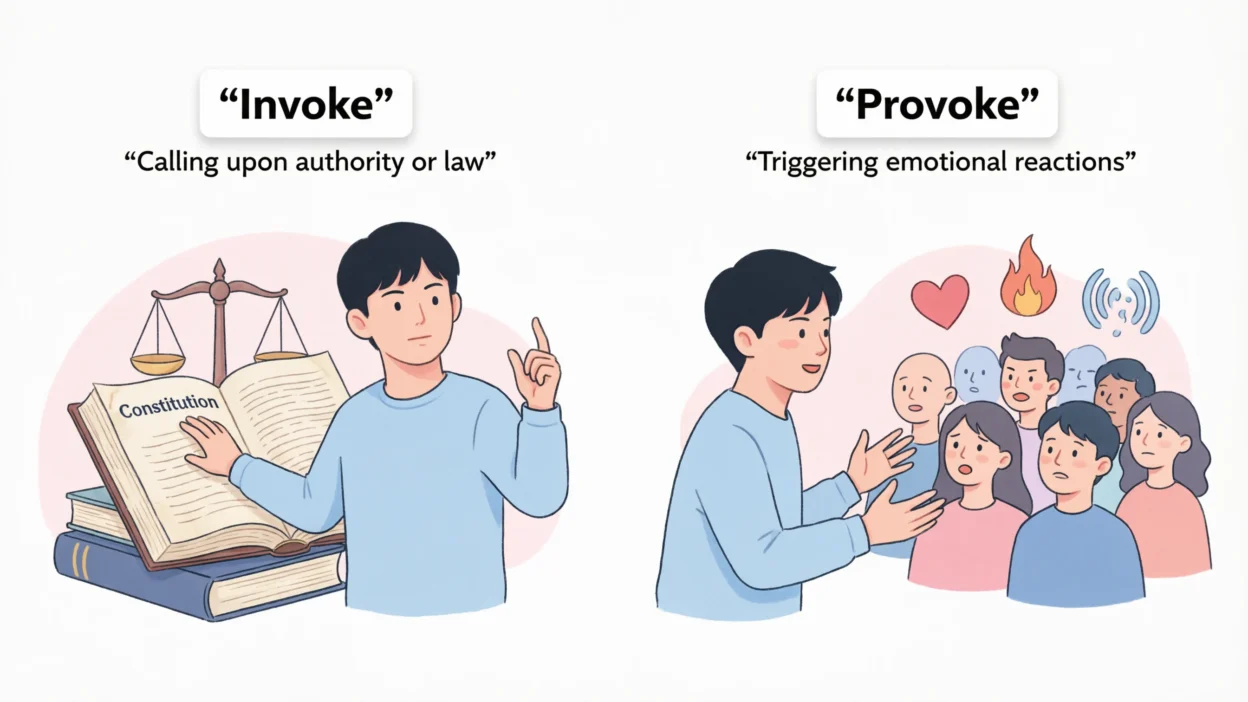
Many English learners confuse “invoke” and “provoke” because the words sound similar and are both verbs. However, they have very different meanings and are used in completely different situations.
The key idea: calling upon something vs causing a reaction.
Understanding this difference will help improve your vocabulary, writing accuracy, and speaking confidence.
Quick Answer
- ✅ Invoke – To call upon, appeal to, or bring something into use
- ✅ Provoke – To trigger or cause a reaction, especially emotional
- ✏️ Remember: Invoke = call upon, Provoke = cause reaction
Clear Explanation
What Does “Invoke” Mean?
Invoke is a verb.
👉 It means:
- to call upon
- to appeal to
- to use a rule, authority, law, memory, or higher power
Examples:
- The lawyer invoked constitutional rights.
- She invoked her right to remain silent.
- The speech invoked memories of childhood.
- The ceremony invoked peace and unity.
- They invoked emergency powers during the crisis.
👉 “Invoke” often appears in:
- law
- religion
- politics
- formal writing
- technology
Common Meanings of “Invoke”
1. To Use a Law or Rule
- The company invoked a special policy.
- He invoked legal protection.
2. To Call Upon Help or Support
- They invoked divine guidance.
- She invoked the support of her community.
3. To Bring Something to Mind
- The music invoked old memories.
- The smell invoked feelings of nostalgia.
What Does “Provoke” Mean?
Provoke is also a verb.
👉 It means:
- to trigger a reaction
- to cause emotion, anger, discussion, or action
Examples:
- His comments provoked outrage.
- The joke provoked laughter.
- The article provoked debate online.
- Loud noises provoked the dog.
- The unfair decision provoked protests.
👉 “Provoke” often involves:
- emotional reactions
- arguments
- conflict
- strong responses
Common Meanings of “Provoke”
1. To Cause Anger
- The insult provoked him.
- Her behavior provoked criticism.
2. To Trigger Discussion or Thought
- The book provoked conversation.
- The speech provoked important questions.
3. To Cause Physical or Emotional Reactions
- Smoke provoked coughing.
- The scene provoked sadness.
Key Difference
| Feature | Invoke | Provoke |
|---|---|---|
| Meaning | Call upon or use | Cause a reaction |
| Focus | Request/use authority or idea | Trigger emotion or response |
| Tone | Often formal or respectful | Often emotional or negative |
| Example | Invoke the law | Provoke anger |
Which One to Use and When
Use “Invoke” When:
- Referring to authority, rules, rights, memories, or support
Examples:
- Invoke a law
- Invoke rights
- Invoke tradition
- Invoke authority
- Invoke memories
Example Sentences:
- The lawyer invoked legal protections.
- She invoked family traditions during the ceremony.
- The image invoked strong memories.
Use “Provoke” When:
- Talking about causing reactions or emotions
Examples:
- Provoke anger
- Provoke laughter
- Provoke debate
- Provoke fear
- Provoke criticism
Example Sentences:
- His speech provoked strong reactions.
- The movie provoked discussion online.
- The rude comment provoked anger.
Common Mistakes People Make
1. Using “Invoke” for Emotional Reactions
❌ His comment invoked anger
✅ His comment provoked anger
2. Using “Provoke” for Legal Rights
❌ She provoked her legal rights
✅ She invoked her legal rights
3. Confusing Formal and Emotional Contexts
- invoke = formal usage
- provoke = reaction-focused usage
4. Mixing Positive and Negative Meanings
“Provoke” is often negative, though not always.
5. Ignoring Context
The surrounding sentence usually reveals the correct choice.
Easy Memory Trick
👉 Invoke = invite/call upon
👉 Provoke = produce reaction
Think:
- invoke authority
- provoke emotion
Real-Life Examples
Correct Use of “Invoke”
- The president invoked emergency powers.
- The song invoked childhood memories.
- She invoked her constitutional rights.
Correct Use of “Provoke”
- The decision provoked protests.
- The comedy show provoked laughter.
- His actions provoked criticism.
Practice Exercise
Fill in the blanks:
- The lawyer ______ the law during the case.
- The speech ______ strong emotions.
- The smell ______ memories of home.
Answers:
- invoked
- provoked
- invoked
Quick Quiz
- Which word means “call upon”?
a) Provoke
b) Invoke - Which word means “cause a reaction”?
a) Invoke
b) Provoke
Correct Answers:
- b) Invoke
- b) Provoke
Why This Confusion Happens
The confusion occurs because:
- both words sound similar
- both are formal verbs
- both often appear in serious writing
However:
- invoke usually involves authority, support, or memory
- provoke usually involves reactions or emotions
Helpful Tip for Better Writing
If you can replace the word with:
- call upon/use → use invoke
- trigger/cause reaction → use provoke
Conclusion
The difference between “invoke” and “provoke” is about meaning and context. Invoke means to call upon or use something such as authority, laws, or memories, while provoke means to trigger reactions, emotions, or responses.
👉 Invoke = call upon/use
👉 Provoke = trigger reaction
Learning this distinction will help you use formal English more accurately and confidentl

Michael Anderson is a professional editor and senior contributor with a background in long-form content and strategic writing. He focuses on quality, structure, and credibility across all publications. Michael brings years of experience in content development and ensures high editorial standards for every project.