
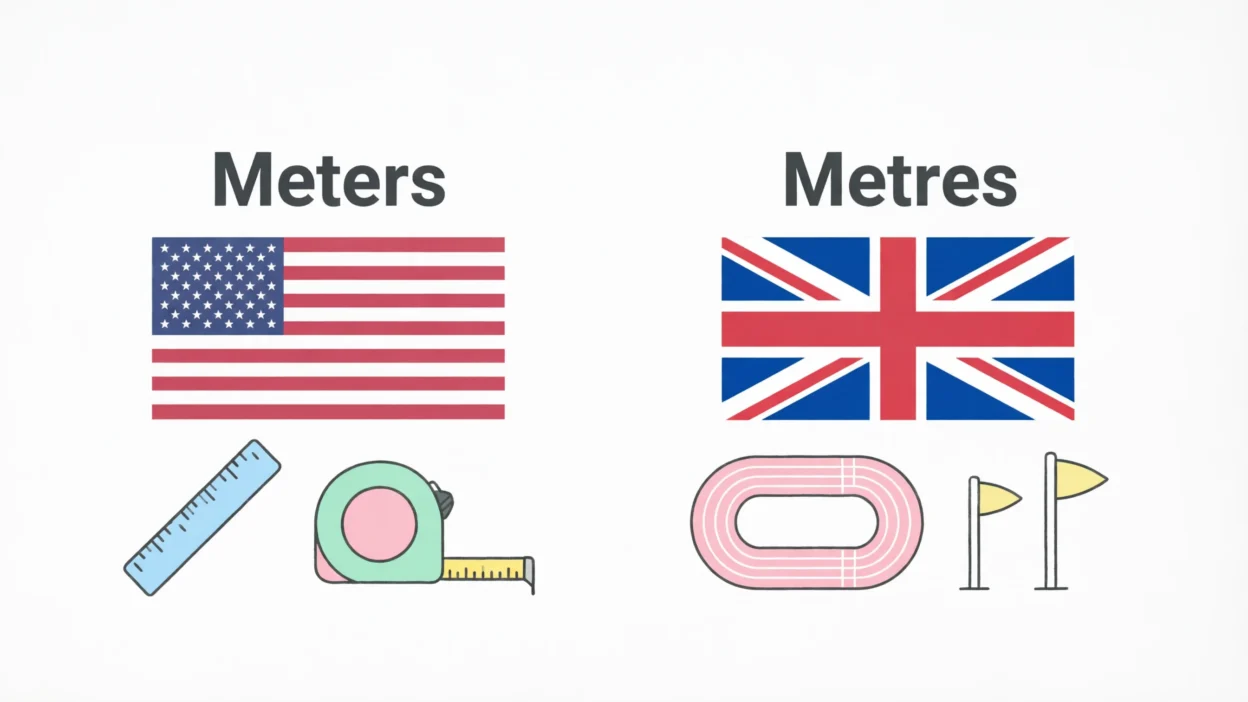
“Meters” and “metres” have the same meaning when referring to the metric unit of length. The difference is mainly based on regional spelling conventions.
The key idea: American English vs British English spelling.
Both words are plural forms of the metric unit equal to 100 centimeters or approximately 3.28 feet.
Understanding the difference will help you choose the correct spelling for your audience.
Quick Answer
- ✅ Meters – American English spelling
- ✅ Metres – British English spelling
- ✏️ Remember: American English uses “meter”; British English uses “metre.”
Clear Explanation
What Does “Meters” Mean?
Meters is the American English plural form of meter.
👉 It refers to:
- the metric unit of length
- distances and measurements
- scientific and engineering calculations
Examples:
- 10 meters
- 50 meters
- 100 meters
- 500 meters
- 1,000 meters
Example Sentences:
- The race was 100 meters long.
- The building is 20 meters tall.
- The lake is 500 meters away.
👉 In American English, meter is used for both:
- the unit of length
- measuring devices (such as a gas meter)
Common Uses of “Meters”
1. Distance Measurements
Examples:
- 100 meters
- 200 meters
Example Sentence:
- She ran 200 meters in the competition.
2. Scientific Measurements
Examples:
- meters per second
- square meters
Example Sentence:
- The room measures 30 square meters.
3. Construction and Engineering
Examples:
- 10 meters high
- 50 meters deep
Example Sentence:
- The tower stands 80 meters tall.
What Does “Metres” Mean?
Metres is the British English plural form of metre.
👉 It has exactly the same meaning:
- the metric unit of length
- distance measurement
- scientific measurement
Examples:
- 10 metres
- 50 metres
- 100 metres
- 500 metres
- 1,000 metres
Example Sentences:
- The race was 100 metres long.
- The building is 20 metres tall.
- The lake is 500 metres away.
👉 In British English:
- metre = unit of length
- meter = measuring device
Common Uses of “Metres”
1. Distance Measurements
Examples:
- 100 metres
- 200 metres
Example Sentence:
- She ran 200 metres in the competition.
2. Scientific Measurements
Examples:
- metres per second
- square metres
Example Sentence:
- The room measures 30 square metres.
3. Construction and Engineering
Examples:
- 10 metres high
- 50 metres deep
Example Sentence:
- The tower stands 80 metres tall.
Key Difference
| Feature | Meters | Metres |
|---|---|---|
| Meaning | Same | Same |
| English Style | American English | British English |
| Unit of Length | Yes | Yes |
| Pronunciation | Same | Same |
Which One to Use and When
Use “Meters” When:
- Writing American English
- Writing for U.S. audiences
- Following American spelling conventions
Examples:
- 100 meters
- 50 meters
- square meters
- meters per second
- 20 meters tall
Example Sentences:
- The runner completed 100 meters.
- The wall is 3 meters high.
- The property covers 500 square meters.
Use “Metres” When:
- Writing British English
- Writing for UK or Commonwealth audiences
- Following British spelling conventions
Examples:
- 100 metres
- 50 metres
- square metres
- metres per second
- 20 metres tall
Example Sentences:
- The runner completed 100 metres.
- The wall is 3 metres high.
- The property covers 500 square metres.
Important British English Note
In British English:
- metre = unit of length
- meter = measuring device
Examples:
- 10 metres long ✅
- electricity meter ✅
- water meter ✅
- gas meter ✅
This distinction is not usually made in American English.
Common Mistakes People Make
1. Mixing American and British Spellings
Avoid using:
- meters
and - metres
in the same document.
2. Forgetting the British Rule
British English uses:
- metre (length)
- meter (measuring device)
3. Thinking the Meanings Differ
Both words represent exactly the same unit of length.
4. Using the Wrong Regional Form
Match the spelling to your audience.
5. Inconsistent Technical Writing
Scientific and engineering documents should follow one spelling convention consistently.
Easy Memory Trick
👉 Meters = American English
👉 Metres = British English
Think:
- American English → meter, meters
- British English → metre, metres
Real-Life Examples
Correct Use of “Meters”
- The race covered 400 meters.
- The building is 50 meters tall.
- The room measures 25 square meters.
Correct Use of “Metres”
- The race covered 400 metres.
- The building is 50 metres tall.
- The room measures 25 square metres.
Practice Exercise
Fill in the blanks:
- American English commonly uses “______.”
- British English commonly uses “______.”
- Both words represent the same metric unit of length.
Answers:
- meters
- metres
- true
Quick Quiz
- Which spelling is American English?
a) Metres
b) Meters - Which spelling is British English?
a) Meters
b) Metres - Do both words represent the same unit of length?
a) Yes
b) No
Correct Answers:
- b) Meters
- b) Metres
- a) Yes
Why This Confusion Happens
The confusion happens because:
- both spellings are correct
- pronunciation is identical
- American and British English follow different spelling conventions
However:
- meters is American English
- metres is British English
Helpful Tip for Better Writing
Stay consistent:
- American English → meters
- British English → metres
Remember:
- In British English, meter usually refers to a measuring device.
Conclusion
The difference between “meters” and “metres” is mainly regional spelling preference. Both words represent the same metric unit of length.
👉 Meters = American English
👉 Metres = British English
Using the correct regional spelling will make your writing clearer, more professional, and better suited to your audience.

Sophia Reynolds is a digital writer and researcher with a focus on modern trends, productivity, and online education. She enjoys exploring new ideas and presenting them in a simple, reader-friendly way. Sophia is committed to creating informative and trustworthy content that helps audiences stay informed and inspired.