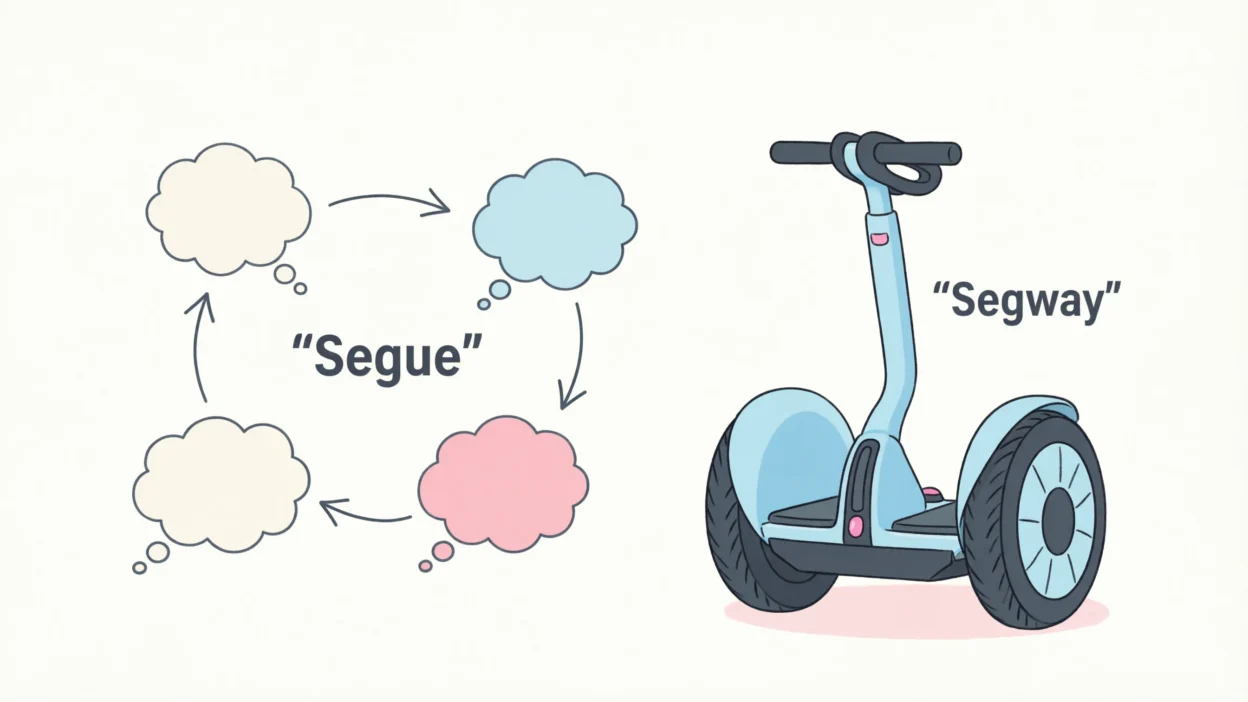
Many learners search for “segway vs segue” because the words sound the same but have completely different meanings. One is a real-world product, and the other is a writing and speaking term.
The key idea: device vs transition.
Quick Answer
- ❌ Segway – A brand name (two-wheeled scooter)
- ✅ Segue – A smooth transition from one topic to another
- ✏️ Remember: Segue = smooth switch, Segway = scooter
Clear Explanation
What Does “Segue” Mean?
Segue is a verb (and noun) used in writing and speaking.
👉 It means:
- to move smoothly from one idea to another
- a transition between topics
Examples:
- Let’s segue into the next topic.
- The speaker segued into a new idea.
- That was a smooth segue.
- The article segues well between sections.
- She used a clever segue in her speech.
What Does “Segway” Mean?
Segway is a brand name for a two-wheeled personal transport device.
👉 It is a proper noun, not a general word for transitions.
Examples:
- He rode a Segway in the park.
- The tour used Segways.
- She bought a Segway scooter.
Comparison Table
| Feature | Segue | Segway |
|---|---|---|
| Meaning | Smooth transition | Personal scooter |
| Type | Verb / noun | Brand name |
| Usage | Writing & speaking | Transportation |
| Example | Segue into topic | Ride a Segway |
Which One to Use and When
Use “Segue” When:
- Talking about transitions in speech or writing
- Moving from one idea to another
Examples:
- Let’s segue into the next point.
- He smoothly segued into another topic.
- The essay segues nicely.
- She used a good segue.
- The presentation segued perfectly.
Use “Segway” When:
- Talking about the vehicle
Examples:
- He rode a Segway.
- The tourists used Segways.
- She rented a Segway.
Important Note ⚠️
Many people mistakenly write:
❌ Let’s segway into the topic
✅ Let’s segue into the topic
👉 This is one of the most common spelling mistakes.
Common Mistakes People Make
1. Using “Segway” for Writing
❌ Segway into the next topic
✅ Segue into the next topic
2. Confusing Pronunciation
Both words sound the same (“seg-way”).
3. Not Knowing It’s a Brand Name
“Segway” is a proper noun.
4. Spelling Based on Sound
English spelling is not always phonetic.
5. Ignoring Context
Meaning depends on situation.
Everyday Real-Life Examples
Writing & Speaking
- “Let’s segue into the next idea.”
- “That was a smooth segue.”
Travel
- “He rode a Segway.”
- “They toured the city on Segways.”
Conversations
- “Nice segue!”
- “Have you tried a Segway?”
School
- “Use a segue in your essay.”
- “The paragraph segues well.”
Short Learning Section
Easy Rule to Remember
- Segue = transition
- Segway = scooter
Memory Tip
“Segue = smooth (both start with ‘se’)”
Practice Exercise
Fill in the blanks:
- Let’s ______ into the next topic.
- He rode a ______.
- The speaker ______ smoothly.
Answers:
- segue
- Segway
- segued
Quick Quiz
Choose the correct option:
- Let’s ______ into the next point.
a) Segway
b) Segue - He bought a ______.
a) Segue
b) Segway
Correct Answers:
- b) Segue
- b) Segway
Frequently Asked Questions (FAQs)
1. What does “segue” mean?
2. What is “Segway”?
A personal transport device.
3. Why are they confused?
They sound the same.
4. Which one is used in writing?
Segue.
5. Is “segway” correct in writing?
No, unless talking about the device.
6. Is this a common mistake?
Yes, very common.
7. How can I remember it?
Segue = smooth transition.
8. Is Segway a brand?
Yes.
Conclusion
The difference between “segue” and “Segway” is simple but important. Segue is used for smooth transitions in writing or speech, while Segway is a type of scooter.
To avoid mistakes, remember:
👉 Segue = transition
👉 Segway = scooter

Sophia Reynolds is a digital writer and researcher with a focus on modern trends, productivity, and online education. She enjoys exploring new ideas and presenting them in a simple, reader-friendly way. Sophia is committed to creating informative and trustworthy content that helps audiences stay informed and inspired.