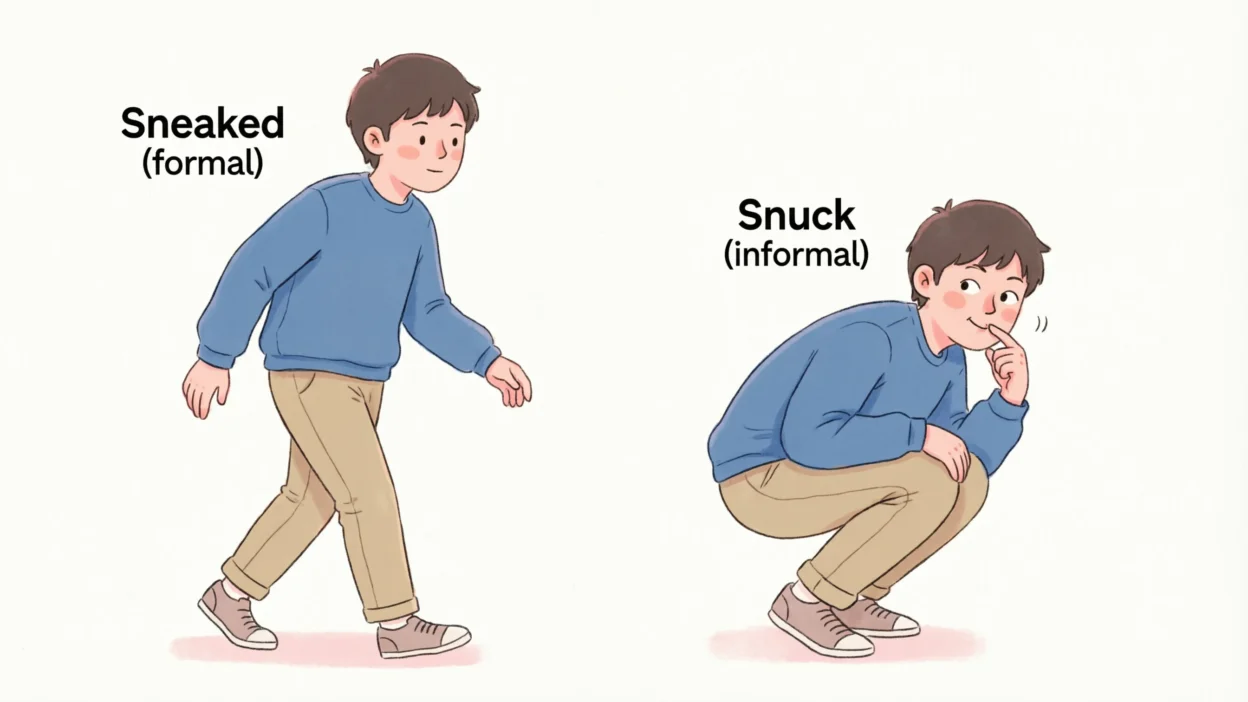
Many learners search for “sneaked vs snuck” because both are used as the past tense of “sneak.” Unlike many other verb pairs, both forms are correct, but they differ in usage and tone.
The key idea: formal vs informal preference.
Quick Answer
- ✅ Sneaked – Traditional and more formal
- ✅ Snuck – Informal but very common (especially in American English)
- ✏️ Remember: Both are correct, context matters
Clear Explanation
What Does “Sneaked” Mean?
Sneaked is the original past tense of sneak.
👉 It is:
- more formal
- preferred in formal writing and exams
Examples:
- He sneaked out of the room.
- She sneaked a look at the paper.
- They sneaked into the building.
- He sneaked behind the door.
- She sneaked away quietly.
What Does “Snuck” Mean?
Snuck is an irregular past form that became popular over time.
👉 It is:
- informal
- widely used in everyday speech
Examples:
- He snuck out last night.
- She snuck a cookie.
- They snuck into the movie.
- He snuck past the guard.
- She snuck away quietly.
Comparison Table
| Feature | Sneaked | Snuck |
|---|---|---|
| Type | Regular form | Irregular form |
| Tone | Formal | Informal |
| Usage | Writing, exams | Speech, casual use |
| Example | He sneaked out | He snuck out |
Which One to Use and When
Use “Sneaked” When:
- Writing formally
- In exams or academic work
- In professional communication
Examples:
- He sneaked into the room.
- She sneaked a glance.
- They sneaked away quietly.
- He sneaked behind the wall.
- She sneaked out silently.
Use “Snuck” When:
- Speaking casually
- Writing informally
- In everyday conversation
Examples:
- He snuck out last night.
- She snuck a snack.
- They snuck into the party.
- He snuck past security.
- She snuck away.
Important Note
In modern English, especially in the U.S., “snuck” is extremely common and often preferred in speech.
However:
- Teachers and formal writing still prefer “sneaked.”
Common Mistakes People Make
1. Thinking One Is Wrong
Both are correct.
2. Using “Snuck” in Formal Writing
Better to use sneaked.
3. Not Knowing Context
Formal vs informal matters.
4. Overthinking Grammar
Both forms are accepted.
5. Ignoring Regional Usage
“Snuck” is more common in American English.
Everyday Real-Life Examples
Conversations
- “He snuck out.”
- “She sneaked a look.”
School
- “Use sneaked in writing.”
- “Snuck is okay in speech.”
Stories
- “He sneaked into the castle.”
- “They snuck past the guards.”
Daily Life
- “She snuck a snack.”
- “He sneaked away quietly.”
Short Learning Section
Easy Rule to Remember
- Sneaked = formal
- Snuck = informal
Memory Tip
“Snuck sounds quick—used in quick speech.”
Practice Exercise
Fill in the blanks:
- He ______ out last night.
- She ______ a look at the paper.
- They ______ into the room.
Answers:
- snuck / sneaked
- sneaked
- snuck / sneaked
Quick Quiz
Choose the correct option:
- Which is better for formal writing?
a) Snuck
b) Sneaked - Which is common in speech?
a) Sneaked
b) Snuck
Correct Answers:
- b) Sneaked
- b) Snuck
Frequently Asked Questions (FAQs)
1. Is “snuck” correct?
Yes, it is widely accepted.
2. Is “sneaked” correct?
Yes, it is the traditional form.
3. Which should I use in exams?
Use sneaked.
4. Which is more common?
Snuck in speech.
5. Are they interchangeable?
Yes, in most cases.
6. Is this a common confusion?
Yes, very common.
7. Which is more formal?
Sneaked.
8. How can I remember it?
Sneaked = formal, snuck = casual.
Conclusion
The difference between “sneaked” and “snuck” is mainly about formality. Both are correct past forms of sneak, but sneaked is preferred in formal writing, while snuck is more common in everyday speech.
To keep it simple:
👉 Sneaked = formal
👉 Snuck = informal

Emily Carter is a content writer and editor based in the United States, specializing in lifestyle, wellness, and personal development topics. With a passion for clear and engaging storytelling, she creates content that connects with readers and delivers practical value. Emily focuses on making complex ideas easy to understand and relatable.