Many learners search for “per se vs per say” because the phrase sounds like “per say” in speech. However, only one form is correct in English.
The key idea: Latin phrase vs spelling mistake.
Quick Answer
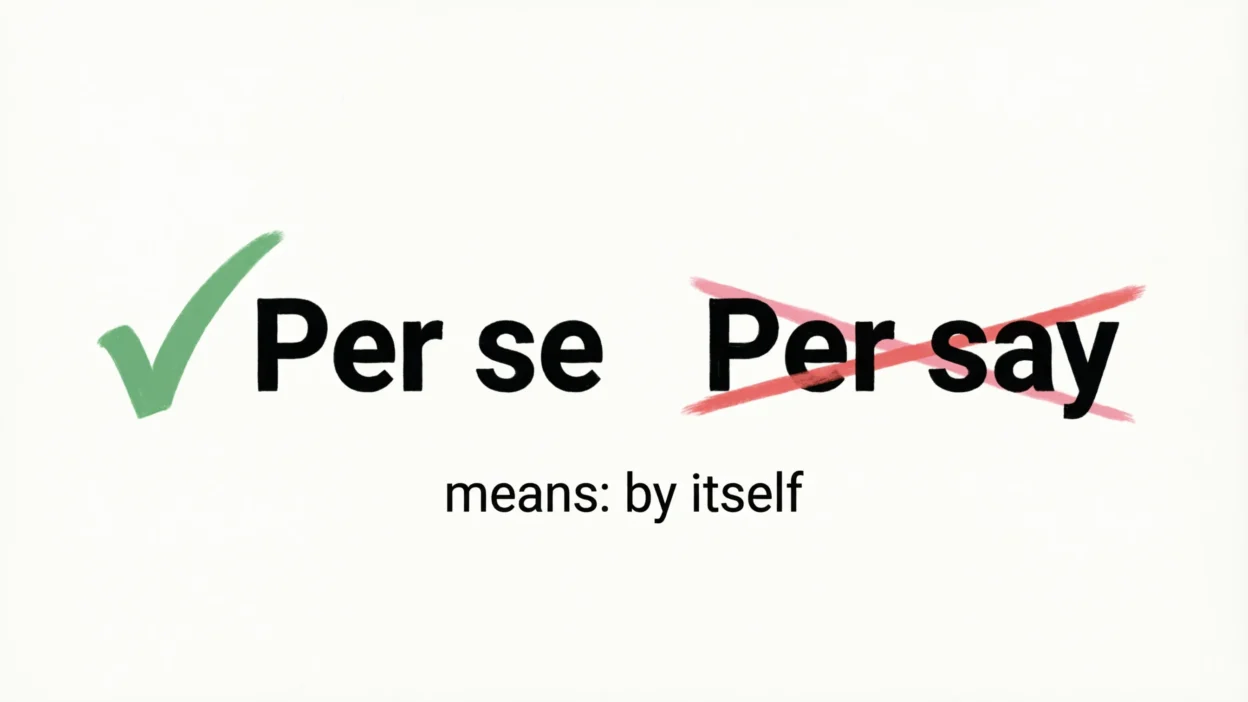
- ✅ Per se – Correct phrase meaning “by itself” or “in itself”
- ❌ Per say – Incorrect spelling
- ✏️ Remember: Per se = correct, Per say = wrong
Clear Explanation
What Does “Per Se” Mean?
Per se is a Latin phrase used in English.
👉 It means:
- by itself
- in itself
- intrinsically
Examples:
- The idea isn’t bad per se.
- Money isn’t evil per se.
- The plan isn’t wrong per se.
- It’s not a problem per se.
- The method isn’t flawed per se.
👉 It is used to soften or clarify a statement.
What About “Per Say”?
❌ Per say is not correct.
👉 It is a common misspelling caused by pronunciation.
Comparison Table
| Feature | Per se | Per say |
|---|---|---|
| Spelling | Correct | Incorrect |
| Origin | Latin | Error |
| Meaning | By itself | No meaning |
| Usage | Standard English | Not used |
Which One to Use
Always Use “Per Se”
Examples:
- It’s not wrong per se.
- The design isn’t bad per se.
- That’s not the issue per se.
- It’s not illegal per se.
- The idea isn’t new per se.
Never Use “Per Say”
❌ Avoid this spelling in all writing.
How to Use “Per Se” Correctly
👉 It usually comes at the end of a sentence.
✔ Example:
- It’s not dangerous per se.
👉 It often follows a negative or limiting statement.
✔ Example:
- I don’t dislike it per se.
Common Mistakes People Make
1. Writing “Per Say”
❌ per say
✅ per se
2. Spelling Based on Sound
It sounds like “say” but is spelled se.
3. Overusing the Phrase
Use it only when needed.
4. Misunderstanding Meaning
It does not mean “exactly”—it means “in itself.”
5. Incorrect Placement
Usually placed at the end of a clause.
Everyday Real-Life Examples
Conversations
- “It’s not bad per se.”
- “I don’t hate it per se.”
Work
- “The system isn’t broken per se.”
- “The idea isn’t wrong per se.”
School
- “The answer isn’t incorrect per se.”
- “The method isn’t flawed per se.”
Daily Life
- “It’s not a problem per se.”
- “That’s not the issue per se.”
Short Learning Section
Easy Rule to Remember
Always write “per se,” never “per say.”
Memory Tip
“Se = standard expression”
Practice Exercise
Fill in the blanks:
- It’s not bad ______.
- The idea isn’t wrong ______.
- That’s not the issue ______.
Answers:
- per se
- per se
- per se
Quick Quiz
Choose the correct option:
- It’s not illegal ______.
a) Per say
b) Per se - Which is correct?
a) Per say
b) Per se
Correct Answers:
- b) Per se
- b) Per se
Frequently Asked Questions (FAQs)
1. Is “per say” correct?
No, it is incorrect.
2. What is the correct form?
Per se.
3. What does “per se” mean?
It means “by itself” or “in itself.”
4. Why do people write “per say”?
Because of pronunciation confusion.
5. Is this a common mistake?
Yes, very common.
6. Where is “per se” used?
In formal and informal English.
7. Is it a Latin phrase?
Yes.
8. How can I remember it?
Always use se, not “say.”
Conclusion
The difference between “per se” and “per say” is simple. Per se is the correct phrase meaning “in itself,” while per say is a common spelling mistake.
To avoid errors, remember:
👉 Per se = correct
👉 Per say = incorrect

Emily Carter is a content writer and editor based in the United States, specializing in lifestyle, wellness, and personal development topics. With a passion for clear and engaging storytelling, she creates content that connects with readers and delivers practical value. Emily focuses on making complex ideas easy to understand and relatable.