
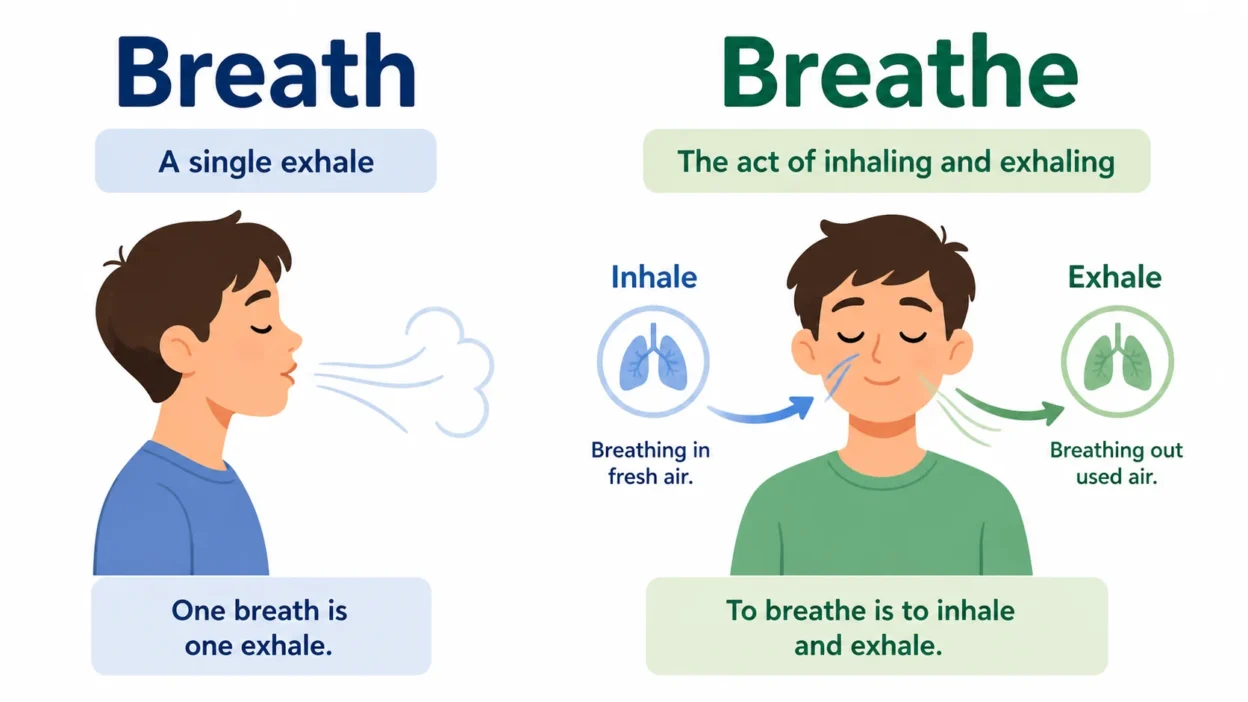
Many learners confuse “breath” and “breathe” because they look very similar. The difference is small—but important.
The key idea: noun vs verb.
Quick Answer
- ✅ Breath – A noun (the air you take in or out)
- ✅ Breathe – A verb (the action of taking air in and out)
- ✏️ Remember: Breath = thing, Breathe = action
Clear Explanation
What Does “Breath” Mean?
Breath is a noun.
👉 It means:
- the air you inhale or exhale
- one cycle of breathing
Examples:
- Take a deep breath.
- I could feel my breath getting faster.
- His breath was cold.
- She held her breath.
- I need a moment to catch my breath.
What Does “Breathe” Mean?
Breathe is a verb.
👉 It means:
- to take air in and out of your lungs
Examples:
- Try to breathe slowly.
- I can’t breathe properly.
- She breathed deeply.
- He is breathing heavily.
- Just breathe and relax.
Key Difference
| Feature | Breath | Breathe |
|---|---|---|
| Type | Noun | Verb |
| Meaning | Air | Action |
| Usage | Thing | Action |
| Example | Take a breath | Try to breathe |
Which One to Use and When
Use “Breath” When:
- Talking about air
- Referring to a thing
Examples:
- Take a deep breath.
- His breath smelled bad.
- I lost my breath.
- She held her breath.
- Catch your breath.
Use “Breathe” When:
- Talking about the action
- Describing breathing
Examples:
- Breathe slowly.
- I can’t breathe.
- He breathed deeply.
- She is breathing fast.
- Try to breathe calmly.
Common Mistakes People Make
1. Mixing Noun and Verb
❌ Take a deep breathe
✅ Take a deep breath
2. Missing “E”
❌ I can’t breath
✅ I can’t breathe
3. Spelling Confusion
They differ by just one letter.
4. Ignoring Grammar Role
One is a noun, the other is a verb.
5. Fast Typing Errors
Very common in writing.
Pronunciation Tip
- Breath → ends with soft “th” (like death)
- Breathe → ends with “th” + vibration (like seethe)
Everyday Real-Life Examples
Health
- “Take a deep breath.”
- “Try to breathe slowly.”
Exercise
- “Catch your breath.”
- “Breathe in and out.”
Emotions
- “She held her breath.”
- “He couldn’t breathe from fear.”
Daily Life
- “I lost my breath running.”
- “Just breathe and relax.”
Short Learning Section
Easy Rule to Remember
- Breath = noun (thing)
- Breathe = verb (action)
Memory Tip
“Breathe has extra ‘e’ = extra action”
Practice Exercise
Fill in the blanks:
- Take a deep ______.
- Try to ______ slowly.
- I lost my ______.
Answers:
- breath
- breathe
- breath
Quick Quiz
Choose the correct option:
- I can’t ______ properly.
a) Breath
b) Breathe - Take a deep ______.
a) Breathe
b) Breath
Correct Answers:
- b) Breathe
- b) Breath
Frequently Asked Questions (FAQs)
1. What does “breath” mean?
It means the air you inhale or exhale.
2. What does “breathe” mean?
It means to take air in and out.
3. Are they interchangeable?
No, they are different.
4. Why are they confusing?
They look very similar.
5. Is this a common mistake?
Yes, very common.
6. Which is a verb?
Breathe.
7. Which is a noun?
Breath.
8. How can I remember it?
“Breathe = action (extra ‘e’).”
Conclusion
The difference between “breath” and “breathe” is simple. Breath is a noun (air), while breathe is a verb (action).
To avoid mistakes, remember:
👉 Breath = thing
👉 Breathe = action

Sophia Reynolds is a digital writer and researcher with a focus on modern trends, productivity, and online education. She enjoys exploring new ideas and presenting them in a simple, reader-friendly way. Sophia is committed to creating informative and trustworthy content that helps audiences stay informed and inspired.