
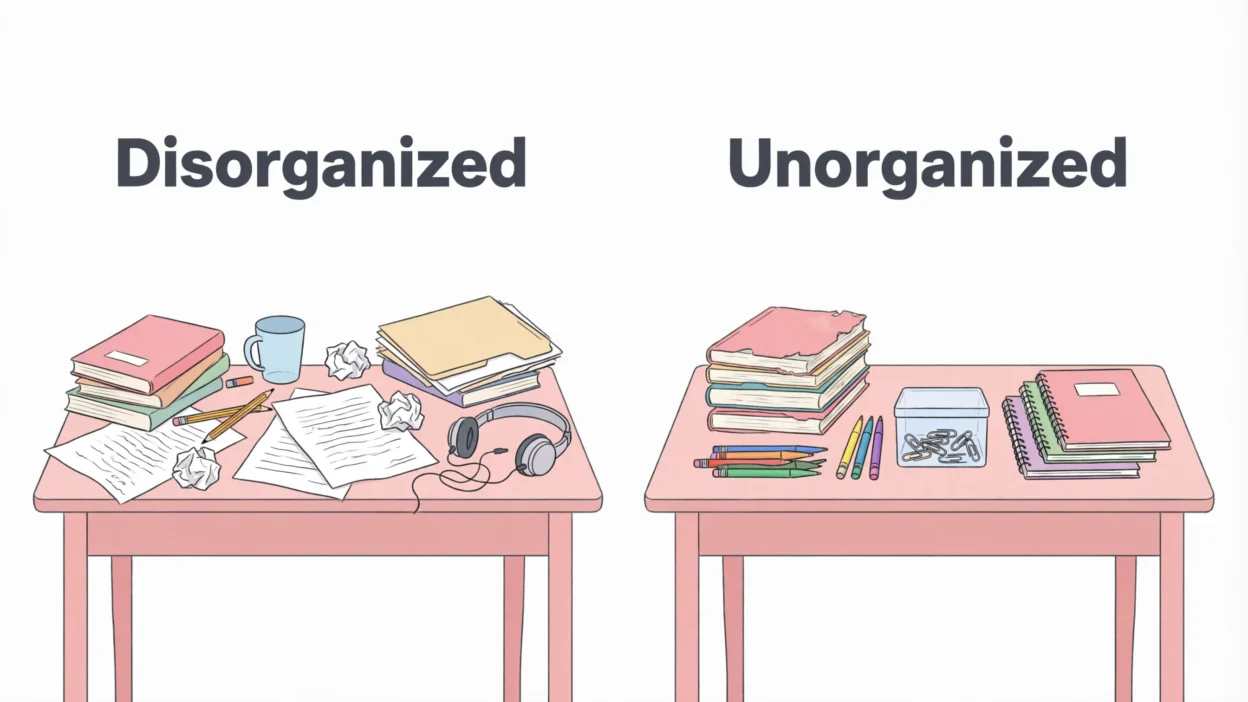
Many learners search for “disorganized vs unorganized” because both words seem to mean the same thing. While they are similar, there is a small but important difference in usage and tone.
The key idea: one describes a messy state, the other means not yet arranged.
Quick Answer
- ✅ Disorganized – Messy, chaotic, lacking order
- ✅ Unorganized – Not organized yet (neutral meaning)
- ✏️ Remember: Disorganized = messy, Unorganized = not arranged
Clear Explanation of the Difference
What Does “Disorganized” Mean?
Disorganized is an adjective that describes something that lacks order or structure.
👉 It often has a negative meaning.
Examples:
- His desk is disorganized.
- The event was completely disorganized.
- She is very disorganized at work.
- The files are disorganized.
- The plan seemed disorganized.
👉 It suggests:
- confusion
- chaos
- poor planning
What Does “Unorganized” Mean?
Unorganized is also an adjective, but it usually means something is not yet organized, not necessarily messy.
👉 It is more neutral in tone.
Examples:
- The data is still unorganized.
- The group is unorganized.
- These papers are unorganized.
- The project remains unorganized.
- The files are unorganized for now.
👉 It suggests:
- incomplete arrangement
- not yet structured
Key Difference
| Feature | Disorganized | Unorganized |
|---|---|---|
| Meaning | Messy / chaotic | Not yet arranged |
| Tone | Negative | Neutral |
| Usage | Poor organization | Lack of organization (temporary) |
| Example | Disorganized desk | Unorganized data |
Which One to Use and When
Use “Disorganized” When:
- Something is messy or chaotic
- There is poor structure or planning
Examples:
- The meeting was disorganized.
- His room is disorganized.
- She gave a disorganized speech.
- The system is disorganized.
- The office looks disorganized.
Use “Unorganized” When:
- Something is not yet arranged
- It may be organized later
Examples:
- The files are unorganized.
- The data is unorganized.
- The team is unorganized for now.
- The documents remain unorganized.
- The schedule is unorganized.
Important Note
In modern English, “disorganized” is much more common than “unorganized.”
👉 In many cases, people use disorganized for both meanings.
Common Mistakes People Make
1. Using Both as Exactly the Same
They are similar but not identical.
2. Overusing “Unorganized”
“Disorganized” is more natural in most cases.
3. Ignoring Tone
- Disorganized = negative
- Unorganized = neutral
4. Confusing Context
Meaning depends on situation.
5. Not Knowing Usage Frequency
“Unorganized” is less common.
Everyday Real-Life Examples
Work
- “The office is disorganized.”
- “The files are unorganized.”
School
- “His notes are disorganized.”
- “The data is unorganized.”
Daily Life
- “Her room is disorganized.”
- “These items are unorganized.”
Events
- “The event was disorganized.”
- “The plan is still unorganized.”
Conversations
- “Everything looks disorganized.”
- “It’s just unorganized for now.”
Short Learning Section for Students
Easy Rule to Remember
- Disorganized = messy
- Unorganized = not yet organized
Memory Tip
“Dis = disorder, Un = not yet.”
Practice Exercise
Fill in the blanks:
- His desk is ______.
- The data is still ______.
- The event was ______.
Answers:
- disorganized
- unorganized
- disorganized
Quick Quiz
Choose the correct option:
- The meeting was ______.
a) Unorganized
b) Disorganized - The files are still ______.
a) Disorganized
b) Unorganized
Correct Answers:
- b) Disorganized
- b) Unorganized
Frequently Asked Questions (FAQs)
1. Do “disorganized” and “unorganized” mean the same?
Not exactly, but they are similar.
2. Which one is more common?
Disorganized is more commonly used.
3. Is “unorganized” incorrect?
No, it is correct but less common.
4. Which one is more negative?
Disorganized.
5. Can I use “disorganized” for everything?
In most cases, yes.
6. Is this a common confusion?
Yes, very common.
7. Which is better in writing?
Disorganized is usually preferred.
8. How can I remember it?
“Dis = messy, Un = not yet.”
Conclusion
The difference between “disorganized” and “unorganized” is subtle but useful. Disorganized describes something messy or chaotic, while unorganized simply means not yet arranged.
To keep it simple:
👉 Disorganized = messy
👉 Unorganized = not arranged yet
Using the right word will make your English clearer and more precise.

Michael Anderson is a professional editor and senior contributor with a background in long-form content and strategic writing. He focuses on quality, structure, and credibility across all publications. Michael brings years of experience in content development and ensures high editorial standards for every project.