
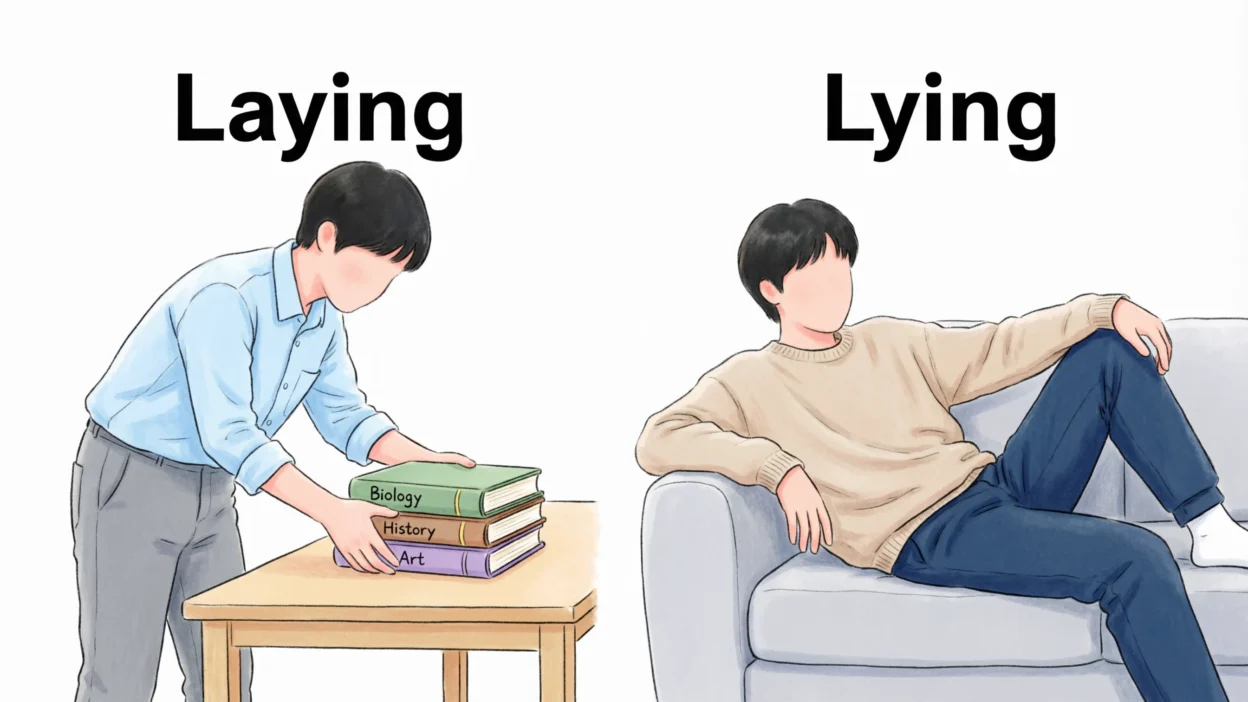
“Laying” and “lying” are commonly confused because they come from the verbs lay and lie, which already cause confusion in English grammar.
The key idea: placing something vs reclining/resting.
Understanding the difference will help you avoid one of the most frequent grammar mistakes in spoken and written English.
Quick Answer
- ✅ Laying – Putting or placing something down
- ✅ Lying – Resting, reclining, or being in a flat position
- ✏️ Remember: Laying needs an object, Lying does not
Clear Explanation
What Does “Laying” Mean?
Laying comes from the verb lay.
👉 It means:
- placing something somewhere
- putting something down
👉 It requires a direct object.
Examples:
- She is laying the books on the table.
- Workers are laying bricks.
- He was laying carpet yesterday.
- The hen is laying eggs.
- They are laying blankets on the floor.
👉 Ask:
Laying what?
If there is an object, “laying” is usually correct.
Common Uses of “Laying”
1. Putting Objects Somewhere
Examples:
- laying clothes on the bed
- laying tools down
Example Sentence:
- She is laying the plates on the table.
2. Construction Work
Examples:
- laying tiles
- laying concrete
Example Sentence:
- Workers are laying a new road.
3. Producing Eggs
Examples:
- laying eggs
Example Sentence:
- The bird is laying eggs in the nest.
What Does “Lying” Mean?
Lying comes from the verb lie.
👉 It means:
- reclining
- resting
- being positioned somewhere
👉 It does NOT take a direct object.
Examples:
- He is lying on the couch.
- The cat is lying near the window.
- She was lying in bed all morning.
- The papers are lying on the desk.
- They are lying on the beach.
👉 Ask:
Lying what?
That question does not make sense because “lying” does not need an object.
Common Uses of “Lying”
1. Resting or Reclining
Examples:
- lying down
- lying in bed
Example Sentence:
- I am lying on the sofa.
2. Position or Location
Examples:
- lying on the floor
- lying beside the road
Example Sentence:
- The keys are lying on the counter.
3. Relaxing
Examples:
- lying quietly
- lying comfortably
Example Sentence:
- They were lying in the sun.
Key Difference
| Feature | Laying | Lying |
|---|---|---|
| Meaning | Putting something down | Reclining/resting |
| Needs Object? | Yes | No |
| Example | Laying the book down | Lying on the bed |
| Verb Origin | Lay | Lie |
Which One to Use and When
Use “Laying” When:
- Putting something somewhere
- Moving or placing an object
Examples:
- Laying the phone down
- Laying bricks
- Laying towels out
- Laying the baby in bed
- Laying books on shelves
Example Sentences:
- She is laying the dishes on the counter.
- Workers are laying pipes underground.
- He was laying the cards carefully.
Use “Lying” When:
- Reclining or resting
- Being positioned somewhere
Examples:
- Lying down
- Lying on the couch
- Lying in bed
- Lying on the grass
- Lying quietly
Example Sentences:
- The dog is lying near the fireplace.
- I was lying in bed this morning.
- Several papers are lying on the desk.
Common Mistakes People Make
1. Saying “Laying Down” Instead of “Lying Down”
❌ I’m laying down
✅ I’m lying down
👉 Unless you are placing something down.
2. Forgetting the Object
❌ He is laying on the couch
✅ He is lying on the couch
👉 No object = use “lying.”
3. Confusing the Verb Forms
Remember:
- lay → laying
- lie → lying
4. Using “Laying” for Resting
❌ She was laying in bed
✅ She was lying in bed
5. Confusing “Lying” With “Lying” Meaning Not Telling the Truth
There are two meanings of “lying”:
- lying down = reclining
- lying = saying something false
Context usually makes the meaning clear.
Easy Memory Trick
👉 Laying = placing
👉 Lying = reclining
Or remember:
- laying needs something
- lying works alone
Real-Life Examples
Correct Use of “Laying”
- He is laying the phone on the table.
- Workers are laying bricks outside.
- She is laying blankets on the bed.
Correct Use of “Lying”
- The baby is lying peacefully.
- I’m lying on the sofa.
- The shoes are lying near the door.
Practice Exercise
Fill in the blanks:
- She is ______ the dishes on the counter.
- The dog is ______ near the fireplace.
- Workers are ______ new tiles in the kitchen.
Answers:
- laying
- lying
- laying
Quick Quiz
- Which word requires an object?
a) Lying
b) Laying - Which sentence is correct?
a) I’m laying on the bed
b) I’m lying on the bed - Which word means reclining?
a) Laying
b) Lying
Correct Answers:
- b) Laying
- b) I’m lying on the bed
- b) Lying
Why This Confusion Happens
The confusion happens because:
- the verbs are very similar
- their forms overlap
- spoken English often mixes them incorrectly
However:
- laying means placing something
- lying means resting or reclining
Helpful Tip for Better Writing
If the sentence includes:
- an object being placed → use laying
- resting or reclining → use lying
Conclusion
The difference between “laying” and “lying” is mainly about objects and action. Laying means placing something somewhere and requires an object, while lying means reclining or resting and does not require an object.
👉 Laying = placing something
👉 Lying = reclining/resting
Learning this distinction will improve your grammar and help your English sound more natural.

Michael Anderson is a professional editor and senior contributor with a background in long-form content and strategic writing. He focuses on quality, structure, and credibility across all publications. Michael brings years of experience in content development and ensures high editorial standards for every project.