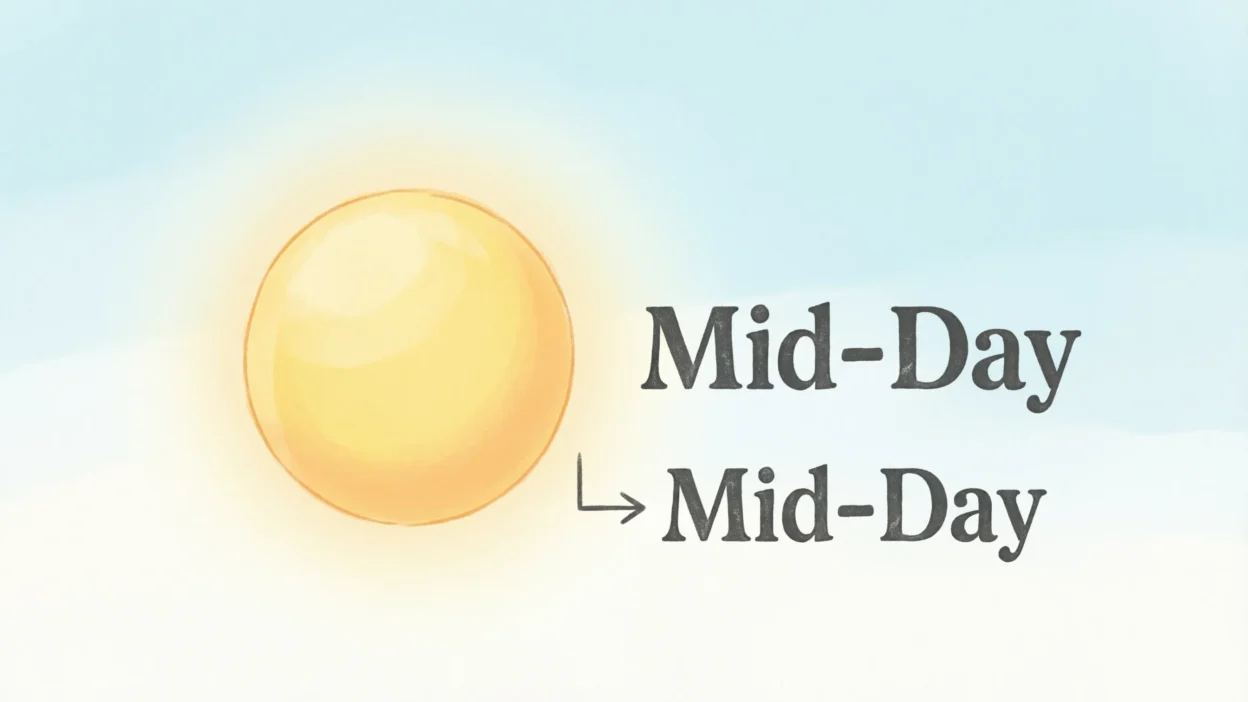
“Mid-day” and “midday” are closely related terms that both refer to the middle of the day, around noon. However, one form is much more common in modern English.
The key idea: hyphenated older style vs standard modern compound word.
Understanding the difference will help you write more naturally and professionally.
Quick Answer
- ✅ Midday – Standard modern spelling meaning noon or the middle of the day
- ✅ Mid-day – Less common hyphenated variant of “midday”
- ✏️ Remember: “Midday” is the preferred modern form
Clear Explanation
What Does “Midday” Mean?
Midday is a noun and sometimes an adjective.
👉 It means:
- noon
- the middle part of the day
- around 12 p.m.
Examples:
- We stopped for lunch at midday.
- The midday sun was extremely hot.
- Shops close briefly at midday.
- They arrived around midday.
- The desert becomes dangerous by midday.
👉 “Midday” is the standard spelling in:
- modern English
- journalism
- books
- academic writing
- business writing
Common Uses of “Midday”
1. Referring to Noon
Examples:
- at midday
- around midday
Example Sentence:
- The meeting begins at midday.
2. Describing Weather or Heat
Examples:
- midday heat
- midday sunlight
Example Sentence:
- The midday temperature reached 40°C.
3. As an Adjective
Examples:
- midday meal
- midday break
Example Sentence:
- Workers took a midday break.
What Does “Mid-Day” Mean?
Mid-day is simply a hyphenated spelling variation of midday.
👉 It has the same meaning:
- noon
- middle of the day
Examples:
- The mid-day sun felt intense.
- We met during the mid-day break.
- Birds became quiet by mid-day.
👉 However:
- it is less common today
- many style guides prefer “midday” without a hyphen
Common Uses of “Mid-Day”
1. Older or Stylistic Writing
Examples:
- mid-day meal
- mid-day rest
Example Sentence:
- Travelers avoided the mid-day heat.
2. Hyphenated Style Preferences
Some publications still use hyphens for compound words.
Key Difference
| Feature | Mid-Day | Midday |
|---|---|---|
| Meaning | Middle of the day | Middle of the day |
| Modern Usage | Less common | More common |
| Style | Older/stylistic | Standard modern form |
| Preferred Today? | Usually no | Yes |
Which One to Use and When
Use “Midday” When:
- Writing modern English
- Following standard spelling conventions
- Writing professionally or academically
Examples:
- Midday heat
- Midday meal
- At midday
- Around midday
- Midday break
Example Sentences:
- We arrived at midday.
- The midday sun was powerful.
- Schools close briefly at midday.
Use “Mid-Day” When:
- Following a specific stylistic preference
- Writing older-style or decorative text
Examples:
- Mid-day heat
- Mid-day rest
Example Sentences:
- The travelers rested during the mid-day heat.
- A mid-day meal was served outdoors.
👉 Even here, “midday” is usually preferred today.
Common Mistakes People Make
1. Thinking the Meanings Are Different
They mean the same thing.
2. Assuming the Hyphen Is Required
❌ mid-day is mandatory
✅ midday is usually preferred
3. Inconsistent Spelling
Avoid switching between:
- midday
- mid-day
in the same piece of writing.
4. Confusing “Midday” With “Midnight”
- midday = noon
- midnight = 12 a.m.
5. Overusing Hyphens
Modern English often removes unnecessary hyphens.
Easy Memory Trick
👉 Midday = modern standard spelling
👉 Mid-day = older hyphenated version
Think:
- today’s dictionaries usually prefer midday
Real-Life Examples
Correct Use of “Midday”
- We ate lunch at midday.
- The midday heat was intense.
- Farmers rested during midday.
Correct Use of “Mid-Day”
- Travelers avoided the mid-day sun.
- The mid-day meal lasted an hour.
Practice Exercise
Fill in the blanks:
- The meeting starts at ______.
- The ______ sun was extremely bright.
- Modern English usually prefers “______” without a hyphen.
Answers:
- midday
- midday
- midday
Quick Quiz
- Which spelling is more common in modern English?
a) Mid-day
b) Midday - Do both words mean the same thing?
a) Yes
b) No - Which sentence is more modern?
a) We met at mid-day
b) We met at midday
Correct Answers:
- b) Midday
- a) Yes
- b) We met at midday
Why This Confusion Happens
The confusion happens because:
- English sometimes changes hyphenated words over time
- both spellings exist
- older books may use “mid-day”
However:
- midday is the preferred modern spelling
- mid-day is now less common
Helpful Tip for Better Writing
For modern English writing:
✅ use midday
unless a style guide specifically requests:
- mid-day
Conclusion
The difference between “mid-day” and “midday” is mostly stylistic. Both mean the middle of the day or noon, but midday is the standard modern spelling, while mid-day is an older hyphenated variation.
👉 Midday = preferred modern spelling
👉 Mid-day = less common older style
Using “midday” will make your writing look cleaner and more modern.

Michael Anderson is a professional editor and senior contributor with a background in long-form content and strategic writing. He focuses on quality, structure, and credibility across all publications. Michael brings years of experience in content development and ensures high editorial standards for every project.