
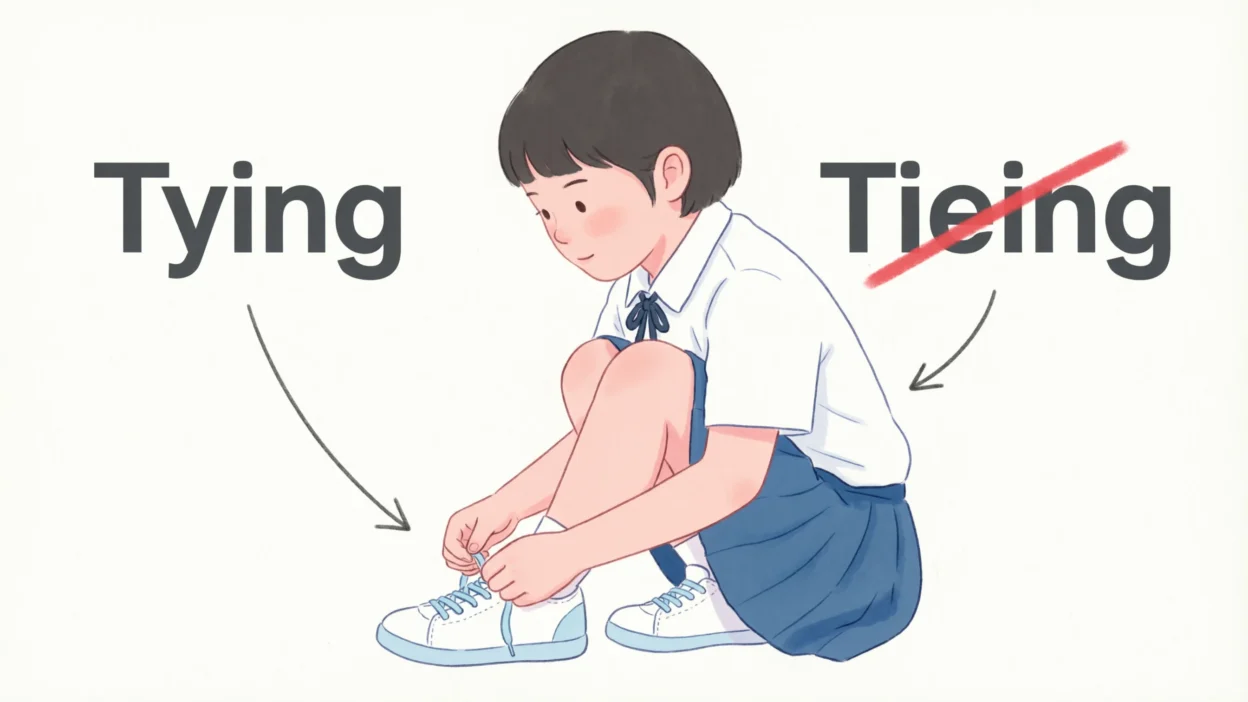
“Tying” and “tieing” are often confused because both appear to come from the verb “tie.” However, only one spelling is considered standard in modern English for most situations.
The key idea: correct modern spelling vs uncommon/usually incorrect variant.
Understanding the difference will help you avoid a common spelling mistake in English writing.
Quick Answer
- ✅ Tying – Correct standard spelling of the present participle of “tie”
- ❌ Tieing – Usually incorrect or extremely uncommon
- ✏️ Remember: Modern English uses “tying”
Clear Explanation
What Does “Tying” Mean?
Tying is the present participle and gerund form of the verb tie.
👉 It means:
- fastening something with a knot
- attaching or securing something
- ending with equal scores in games or competitions
Examples:
- She is tying her shoes.
- He spent hours tying fishing knots.
- The teams are tying in the final minutes.
- They are tying ribbons around the gifts.
- I’m tying the rope carefully.
👉 “Tying” is the correct spelling used in:
- modern English
- schools
- dictionaries
- professional writing
Common Uses of “Tying”
1. Fastening or Securing
Examples:
- tying shoes
- tying ropes
Example Sentence:
- He is tying the package securely.
2. Decorating
Examples:
- tying ribbons
- tying bows
Example Sentence:
- She is tying ribbons around the balloons.
3. Sports or Competitions
Examples:
- tying the score
- teams tying
Example Sentence:
- The teams are tying late in the game.
What Does “Tieing” Mean?
❌ Tieing is generally considered:
- incorrect in modern English
- a misspelling of “tying”
Historically, “tieing” appeared occasionally in older texts, but today:
✅ tying is the accepted standard spelling.
Why “Tying” Changes Spelling
English often changes spelling when adding -ing.
Example:
- lie → lying
- die → dying
- tie → tying
The silent “e” is removed and the spelling adjusts naturally.
Key Difference
| Feature | Tying | Tieing |
|---|---|---|
| Modern Correct Spelling | Yes | Usually no |
| Common Usage | Standard English | Rare/nonstandard |
| Meaning | Fastening or securing | Usually intended misspelling |
| Preferred Today? | Yes | No |
Which One Should You Use?
Use “Tying”
Whenever you mean:
- fastening
- securing
- making knots
- equalizing scores
Examples:
- tying shoes
- tying knots
- tying ribbons
- tying the game
- tying a package
Example Sentences:
- She is tying her hair back.
- The sailors are tying ropes securely.
- The match is tying near the end.
Avoid “Tieing”
❌ Incorrect:
- She is tieing her shoes.
✅ Correct:
- She is tying her shoes.
Common Mistakes People Make
1. Keeping the “e”
❌ tieing
✅ tying
👉 The “e” is removed.
2. Confusing Spelling Rules
English changes many verbs before adding -ing.
3. Thinking “Tieing” Looks More Logical
Even if it seems logical, standard English prefers:
✅ tying
4. Mixing Old and Modern Spellings
Modern dictionaries almost always use:
- tying
5. Forgetting Similar Patterns
Compare:
- die → dying
- lie → lying
- tie → tying
Easy Memory Trick
👉 Tie loses the “e” before “-ing”
Think:
- tie → tying
just like: - die → dying
Real-Life Examples
Correct Use of “Tying”
- He is tying his tie carefully.
- They are tying the ropes together.
- The teams are tying at halftime.
Incorrect Use of “Tieing”
❌ I am tieing my shoes.
✅ I am tying my shoes.
Practice Exercise
Fill in the blanks:
- She is ______ her shoes.
- The teams are ______ in the final quarter.
- The correct spelling is “______.”
Answers:
- tying
- tying
- tying
Quick Quiz
- Which spelling is standard modern English?
a) Tieing
b) Tying - Which sentence is correct?
a) He is tieing the rope
b) He is tying the rope - What happens to the silent “e”?
a) It stays
b) It is removed
Correct Answers:
- b) Tying
- b) He is tying the rope
- b) It is removed
Why This Confusion Happens
The confusion happens because:
- “tie” naturally looks like it should become “tieing”
- English spelling rules can feel inconsistent
- pronunciation stays the same
However:
- modern English standardizes the spelling as tying
Helpful Tip for Better Writing
When adding -ing to:
- tie
- die
- lie
the silent “e” disappears:
- tying
- dying
- lying
Conclusion
The difference between “tying” and “tieing” is mainly about correct modern spelling. Tying is the accepted standard form of the verb “tie,” while tieing is generally considered incorrect today.
👉 Tying = correct modern spelling
👉 Tieing = usually incorrect
Learning this spelling rule will make your English writing more accurate and professional.

Michael Anderson is a professional editor and senior contributor with a background in long-form content and strategic writing. He focuses on quality, structure, and credibility across all publications. Michael brings years of experience in content development and ensures high editorial standards for every project.