Many learners search for “wholistic vs holistic” because both forms appear online and sound almost the same. The extra “w” in wholistic makes it look related to the word “whole,” which adds to the confusion.
The truth is simple: one form is standard and widely accepted, while the other is rare.
Quick Answer
Here is the clear and simple answer:
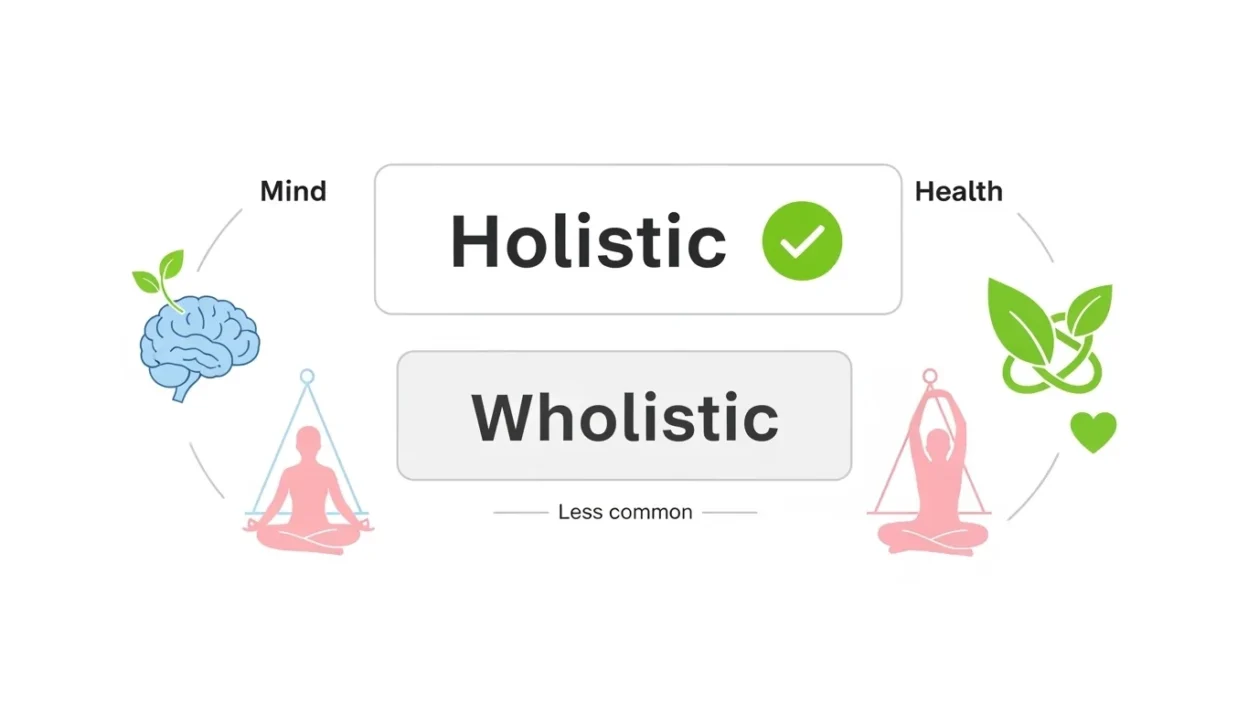
- ✅ Holistic – Correct and standard spelling; means looking at the whole system
- ⚠️ Wholistic – Less common variant; not standard in most writing
- 📚 Use holistic in most situations
- ✏️ Remember: No “w” → holistic
Origin and Background
The word holistic comes from the Greek word “holos,” which means “whole.”
Even though it relates to the idea of “whole,” the correct English spelling does not include “w.”
The form “wholistic” appeared later, likely because people connected it to the English word “whole.”
Clear Explanation of the Difference
What Does “Holistic” Mean?
Holistic is an adjective. It means looking at something as a whole, not just in parts.
Common Meanings
- Complete View
- A holistic approach considers everything.
- Health and Wellness
- Holistic care looks at body and mind.
- General Use
- It focuses on the full picture.
What About “Wholistic”?
Wholistic is a less common spelling. Some people use it, but it is not standard and is often avoided in formal writing.
⚠️ Wholistic = rare or non-standard
✅ Holistic = correct and widely accepted
Comparison Table
| Feature | Holistic | Wholistic |
|---|---|---|
| Spelling | Standard and correct | Less common variant |
| Meaning | Whole or complete approach | Same meaning |
| Usage | Formal and informal English | Limited use |
| Origin | Greek “holos” | Later variation |
| Recommendation | Use this | Avoid in most cases |
Which One to Use and When
Use “Holistic” When:
- Writing essays or reports
- Talking about health, learning, or systems
- Describing a complete approach
Examples:
- She takes a holistic approach to health.
- The teacher uses holistic learning methods.
- We need a holistic plan.
- The program offers holistic care.
- They focus on holistic development.
Use “Wholistic” Carefully
- It may appear in some contexts
- Avoid it in formal or standard writing
Common Mistakes People Make
1. Adding “W” from “Whole”
People connect it to “whole.”
❌ Wholistic
✅ Holistic
2. Thinking Both Are Equal
They are not equally accepted.
3. Using “Wholistic” in Formal Writing
It may look incorrect or unusual.
4. Spelling Based on Logic
Logical thinking leads to wrong spelling.
5. Not Knowing the Origin
Understanding “holos” helps avoid errors.
Everyday Real-Life Examples
Health and Wellness
- “She prefers holistic care.”
- “Holistic treatment looks at the whole body.”
Education
- “The school supports holistic learning.”
- “Holistic education develops all skills.”
Work and Planning
- “We need a holistic strategy.”
- “The company uses a holistic approach.”
Conversations
- “Think in a holistic way.”
- “Take a holistic view.”
Social Media
- “Holistic health is important.”
- “Focus on holistic growth.”
Short Learning Section for Students and Beginners
Easy Rule to Remember
Holistic = correct spelling
Memory Tip
“No ‘w’ → holistic.”
Pronunciation Guide
- Holistic: hoh-LIS-tik
Practice Exercise
Fill in the blanks:
- She uses a ______ approach.
- This is a ______ method.
- They focus on ______ care.
Answers:
- holistic
- holistic
- holistic
Quick Quiz
Choose the correct option:
- A ______ approach helps overall growth.
a) Wholistic
b) Holistic - The program offers ______ care.
a) Holistic
b) Wholistic
Correct Answers:
- b) Holistic
- a) Holistic
Frequently Asked Questions (FAQs)
1. Is “wholistic” correct?
It exists but is not standard.
2. What is the correct spelling?
The correct and common spelling is holistic.
3. What does “holistic” mean?
It means looking at the whole system.
4. Why do people write “wholistic”?
Because they connect it to “whole.”
5. Which should I use in writing?
Use holistic.
6. Is “holistic” used in formal writing?
Yes, it is widely accepted.
7. Are both pronounced the same?
Yes, they sound similar.
8. How can I remember it?
Remember: No “w” → holistic.
Conclusion
The difference between “wholistic” and “holistic” is simple. Holistic is the correct and standard spelling used in everyday and formal English. Wholistic is less common and should usually be avoided.
To stay clear and correct, remember this rule:
👉 Use “holistic,” not “wholistic.”
This will help you write naturally, clearly, and confidently.

Daniel Brooks is a technology and business writer with experience covering innovation, startups, and digital tools. His work emphasizes clarity, accuracy, and real-world application. Daniel aims to help readers understand emerging technologies and make informed decisions in a fast-changing digital landscape.